

Ch. 17 - Reactions at the Alpha-Carbon
Bruice - Organic Chemistry 8th Edition
Bruice8th EditionOrganic ChemistryISBN: 9780135213711Non è quello che usi tu?Cambia libro di testo
Capitolo 17, Problema 69d

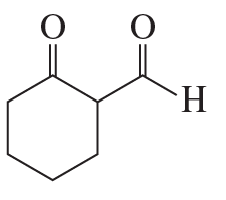
Indicate how the following compounds can be synthesized from cyclohexanone and any other necessary reagents:
d.

Guida verificata passo dopo passo
1
Analyze the target compound and identify the functional groups or structural changes compared to cyclohexanone. For example, determine if there are additions, reductions, oxidations, or rearrangements involved.
Determine the reagents and reaction conditions required to achieve the transformation. For instance, if the target compound involves the reduction of the ketone group in cyclohexanone to an alcohol, consider using a reducing agent like NaBH₄ or LiAlH₄.
If the target compound involves the formation of a new carbon-carbon bond, consider reactions such as aldol condensation, Grignard reaction, or alkylation. Select the appropriate reagent and conditions for the desired transformation.
Plan the sequence of reactions if multiple steps are required. For example, if the target compound involves both reduction and alkylation, decide the order of steps to avoid side reactions or incompatibilities.
Write the overall reaction mechanism for each step, showing how cyclohexanone reacts with the chosen reagents to form the target compound. Use curved arrows to indicate electron flow and ensure all intermediates are accounted for.

Risposta video verificata per un problema simile:

Questa soluzione video è stata consigliata dai nostri tutor come utile per risolvere questo problema.

Concetti chiave

Ecco i concetti essenziali che devi comprendere per rispondere correttamente alla domanda.

Cyclohexanone Reactivity

Cyclohexanone is a ketone that can undergo various reactions due to its carbonyl group. It can participate in nucleophilic addition reactions, where nucleophiles attack the electrophilic carbon of the carbonyl. Understanding its reactivity is crucial for determining how to synthesize other compounds from it.
Video consigliato:
01:17
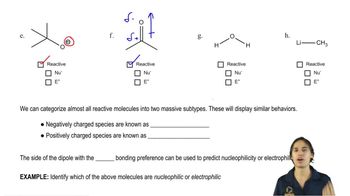
Reactivity of Molecules

Functional Group Transformations

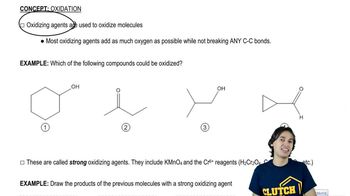
In organic synthesis, functional group transformations involve converting one functional group into another. This is essential for modifying cyclohexanone into desired products. Common transformations include oxidation, reduction, and substitution reactions, which can be facilitated by specific reagents.
Video consigliato:
02:36
Identifying Functional Groups

Reagents and Reaction Conditions

The choice of reagents and reaction conditions significantly influences the outcome of organic reactions. For synthesizing compounds from cyclohexanone, understanding which reagents to use (e.g., Grignard reagents, reducing agents) and the appropriate conditions (temperature, solvent) is vital for achieving the desired products efficiently.
Video consigliato:
01:52
Reagents
Pratica correlata
Domanda del libro di testo

The Reformatsky reaction is an addition reaction in which an organozinc reagent is used instead of a Grignard reagent to add to the carbonyl group of an aldehyde or a ketone. Because the organozinc reagent is less reactive than a Grignard reagent, a nucleophilic addition to the ester group does not occur.

The organozinc reagent is prepared by treating an α-bromo ester with zinc.

Describe how each of the following compounds can be prepared, using a Reformatsky reaction:

c.

871
views
Domanda del libro di testo

The ketone whose 1H NMR spectrum is shown here was obtained as the product of an acetoacetic ester synthesis. What alkyl halide was used in the synthesis?

<IMAGE>

1637
views
Domanda del libro di testo

The Reformatsky reaction is an addition reaction in which an organozinc reagent is used instead of a Grignard reagent to add to the carbonyl group of an aldehyde or a ketone. Because the organozinc reagent is less reactive than a Grignard reagent, a nucleophilic addition to the ester group does not occur. The organozinc reagent is prepared by treating an α-bromo ester with zinc.

Describe how each of the following compounds can be prepared, using a Reformatsky reaction:

a.

701
views
Domanda del libro di testo

Compound A with molecular formula C6H10 has two peaks in its 1H NMR spectrum, both of which are singlets (with ratio 9 : 1). Compound A reacts with an acidic aqueous solution containing mercuric sulfate to form compound B, which gives a positive iodoform test (Problem 58) and has an 1H NMR spectrum that shows two singlets (with ratio 3 : 1). Identify A and B.

1624
views
Domanda del libro di testo

Draw the products of the following reactions:

a.

1099
views
Domanda del libro di testo

b. What carboxylic acid is formed when the malonic ester synthesis is carried out with two equivalents of malonic ester, one equivalent of 1,5-dibromopentane, and two equivalents of base?

1308
views