Ch. 18 - Reactions of Benzene and Substituted Benzenes
Bruice - Organic Chemistry 8th Edition
Bruice8th EditionOrganic ChemistryISBN: 9780135213711Non è quello che usi tu?Cambia libro di testo
Capitolo 18, Problema 90

When heated with chromic acid, compound A forms benzoic acid. Identify compound A from its 1H NMR spectrum.
<IMAGE>

Guida verificata passo dopo passo
1
Step 1: Analyze the 1H NMR spectrum provided. The spectrum shows two distinct signals: one at approximately 7 ppm and another at approximately 2 ppm. The integration values indicate a ratio of 2:3 for these signals.
Step 2: The signal at 7 ppm corresponds to aromatic protons, which are characteristic of a benzene ring. This suggests that compound A contains an aromatic ring.
Step 3: The signal at 2 ppm corresponds to protons in a methyl group (-CH3) attached to the aromatic ring. This indicates that compound A likely has a methyl group directly bonded to the benzene ring.
Step 4: When heated with chromic acid, compound A forms benzoic acid. Chromic acid is a strong oxidizing agent that oxidizes methyl groups attached to aromatic rings into carboxylic acids (-COOH). This confirms that compound A is toluene (methylbenzene).
Step 5: To summarize, the 1H NMR spectrum and the reaction with chromic acid indicate that compound A is toluene, which upon oxidation forms benzoic acid.

Risposta video verificata per un problema simile:

Questa soluzione video è stata consigliata dai nostri tutor come utile per risolvere questo problema.
Durata del video:
8m

Concetti chiave

Ecco i concetti essenziali che devi comprendere per rispondere correttamente alla domanda.

NMR Spectroscopy

Nuclear Magnetic Resonance (NMR) spectroscopy is a powerful analytical technique used to determine the structure of organic compounds. It provides information about the number of hydrogen atoms in different environments within a molecule, indicated by peaks in the spectrum. The chemical shift, measured in parts per million (PPM), reveals the electronic environment of the hydrogen atoms, helping to identify functional groups and molecular structure.
Video consigliato:
10:06
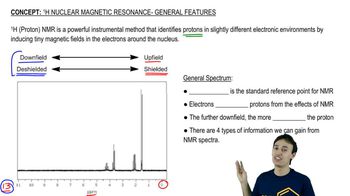
General NMR Features

Chromic Acid Oxidation

Chromic acid is a strong oxidizing agent commonly used in organic chemistry to oxidize alcohols to carbonyl compounds and further to carboxylic acids. In this context, the oxidation of compound A to benzoic acid suggests that compound A is likely a primary or secondary alcohol or an aldehyde. Understanding this reaction is crucial for deducing the structure of compound A based on its transformation.
Video consigliato:
04:15
Monosaccharides - Weak Oxidation (Aldonic Acid)

Chemical Shifts in Aromatic Compounds

In NMR spectroscopy, aromatic protons typically resonate in the range of 6.5 to 8.5 PPM due to the deshielding effect of the aromatic ring. The presence of peaks at specific PPM values can indicate the number of hydrogen atoms on the aromatic ring and their relative positions. Analyzing these shifts helps in identifying the substitution pattern on the aromatic compound, which is essential for determining the structure of compound A.
Video consigliato:
11:44
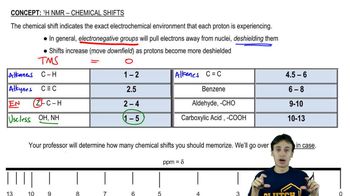
1H NMR Chemical Shifts