Ch. 2 - Acids and Bases: Central to Understanding Organic Chemistry
Bruice - Organic Chemistry 8th Edition
Bruice8th EditionOrganic ChemistryISBN: 9780135213711Non è quello che usi tu?Cambia libro di testo
Capitolo 2, Problema 16a(1,2)

For each of the acid–base reactions in [Section 2.3], compare the pKa values of the acids on either side of the equilibrium arrows to prove that the equilibrium lies in the direction indicated.
1. <IMAGE>
2. <IMAGE>

Guida verificata passo dopo passo
1
Step 1: Identify the acids and bases in the given reactions. In the first image, CH3O−H acts as the acid, donating a proton to H−O−. In the second image, CH3O−H acts as the base, accepting a proton from H3O+.
Step 2: Compare the pKa values of the acids on both sides of the equilibrium. For the first reaction, the pKa of CH3O−H2 (protonated methanol) is −2.5, and the pKa of H2O is 15.7. For the second reaction, the pKa of H3O+ is −1.7, and the pKa of CH3O−H2 is −2.5.
Step 3: Recall that equilibrium favors the side with the weaker acid (higher pKa value). In the first reaction, the equilibrium lies toward the formation of H2O (pKa = 15.7) because it is a weaker acid compared to CH3O−H2 (pKa = −2.5). In the second reaction, the equilibrium lies toward the formation of CH3O−H2 (pKa = −2.5) because it is a weaker acid compared to H3O+ (pKa = −1.7).
Step 4: Analyze the bond-breaking and bond-forming events. In the first image, the bond between CH3O−H breaks, and the lone pair on H−O− forms a new bond with the proton. In the second image, the bond between H3O+ and one of its hydrogens breaks, and the lone pair on CH3O−H forms a new bond with the proton.
Step 5: Summarize the direction of equilibrium based on pKa values and the chemical interactions. The equilibrium in the first reaction favors the formation of H2O and CH3O−, while the equilibrium in the second reaction favors the formation of CH3O−H2 and H2O.

Risposta video verificata per un problema simile:

Questa soluzione video è stata consigliata dai nostri tutor come utile per risolvere questo problema.
Durata del video:
4m

Concetti chiave

Ecco i concetti essenziali che devi comprendere per rispondere correttamente alla domanda.

pK<sub>a</sub> Values

The pK<sub>a</sub> value is a quantitative measure of the strength of an acid in solution. It is the negative logarithm of the acid dissociation constant (K<sub>a</sub>), indicating how readily an acid donates protons (H<sup>+</sup>). Lower pK<sub>a</sub> values correspond to stronger acids, as they dissociate more completely in water.
Video consigliato:
06:27
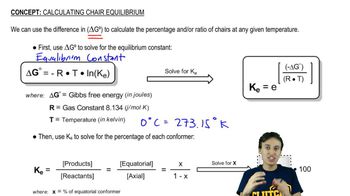
Calculating Chair Equilibrium

Acid-Base Equilibrium

In acid-base reactions, equilibrium refers to the state where the rates of the forward and reverse reactions are equal. The position of equilibrium can be predicted by comparing the pK<sub>a</sub> values of the acids involved; the equilibrium will favor the formation of the weaker acid (higher pK<sub>a</sub>), as it is less likely to donate protons.
Video consigliato:
04:00
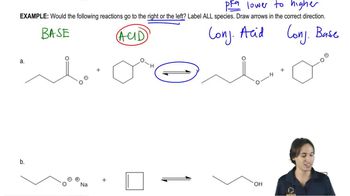
Determining Acid/Base Equilibrium

Bond Formation and Breaking

During acid-base reactions, bonds between atoms are broken and formed. When an acid donates a proton, a bond between the hydrogen and the acid molecule breaks, while a new bond is formed between the proton and the base. Understanding this process is crucial for visualizing how equilibrium shifts based on the strength of the acids and bases involved.
Video consigliato:
02:31
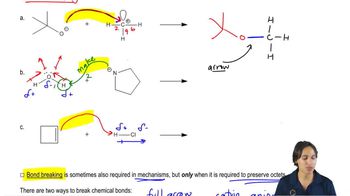
Identifying Bond Breaking
Pratica correlata
Domanda del libro di testo

Does methanol behave as an acid or a base when it reacts with methylamine?

1744
views

Domanda del libro di testo

Ethyne (HC≡CH) has a pKa value of 25, water has a pKa value of 15.7, and ammonia (NH3) has a pKa value of 36. Draw the equation, showing equilibrium arrows that indicate whether reactants or products are favored, for the acid–base reaction of ethyne with

b. −NH2.

c. Which would be a better base to use if you wanted to remove a proton from ethyne, HO− or -NH2?

1527
views
Domanda del libro di testo

For each of the acid–base reactions in [Section 2.3], compare the pKa values of the acids on either side of the equilibrium arrows to prove that the equilibrium lies in the direction indicated.

3. <IMAGE>

4. <IMAGE>

923
views
Domanda del libro di testo

Ethyne (HC≡CH) has a pKa value of 25, water has a pKa value of 15.7, and ammonia (NH3) has a pKa value of 36. Draw the equation, showing equilibrium arrows that indicate whether reactants or products are favored, for the acid–base reaction of ethyne with

a. HO-.

869
views
Domanda del libro di testo

a. Which is a stronger base: CH3COO− or HCOO−? (The pKa of CH3COOH is 4.8; the pKa of HCOOH is 3.8.)

b. Which is a stronger base: HO− or -NH2? (The pKa of H2O is 15.7; the pKa of NH3 is 36.)

c. Which is a stronger base: H2O or CH3OH? (The pKa of H3O+ is −1.7; the pKa of CH3O+H2 is −2.5.)

1388
views
Domanda del libro di testo

Estimate the pKa values of the following compounds:

c. CH3CH2COOH

d. CH3CH2CH2N+H3

1753
views