
Ch. 2 - Acids and Bases: Central to Understanding Organic Chemistry
Bruice - Organic Chemistry 8th Edition
Bruice8th EditionOrganic ChemistryISBN: 9780135213711Non è quello che usi tu?Cambia libro di testo
Capitolo 2, Problema 15

Does methanol behave as an acid or a base when it reacts with methylamine?

Guida verificata passo dopo passo
1
Step 1: Begin by identifying the functional groups in methanol and methylamine. Methanol (CH₃OH) contains a hydroxyl (-OH) group, while methylamine (CH₃NH₂) contains an amine (-NH₂) group.
Step 2: Recall the Brønsted-Lowry acid-base theory, which defines acids as proton (H⁺) donors and bases as proton acceptors. Analyze the ability of methanol and methylamine to donate or accept protons.
Step 3: Consider the hydroxyl group in methanol. The oxygen atom in the -OH group is electronegative, making the hydrogen atom slightly positive and capable of being donated as a proton (H⁺). This suggests methanol can act as a Brønsted-Lowry acid.
Step 4: Examine the amine group in methylamine. The nitrogen atom has a lone pair of electrons, which makes it capable of accepting a proton (H⁺). This indicates methylamine can act as a Brønsted-Lowry base.
Step 5: Conclude that when methanol reacts with methylamine, methanol behaves as an acid by donating a proton (H⁺), and methylamine behaves as a base by accepting the proton.

Risposta video verificata per un problema simile:

Questa soluzione video è stata consigliata dai nostri tutor come utile per risolvere questo problema.
Durata del video:
2m

Concetti chiave

Ecco i concetti essenziali che devi comprendere per rispondere correttamente alla domanda.

Acid-Base Theory

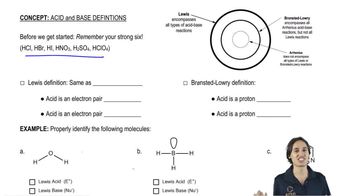
Acid-base theory explains the behavior of substances in terms of proton (H+) transfer. According to the Brønsted-Lowry theory, acids are proton donors, while bases are proton acceptors. Understanding this theory is crucial for analyzing the interaction between methanol and methylamine, as it determines which compound acts as an acid and which acts as a base in their reaction.
Video consigliato:
02:49
The Lewis definition of acids and bases.

Methanol as a Weak Acid

Methanol (CH3OH) can act as a weak acid due to its ability to donate a proton to a stronger base. In the context of its reaction with methylamine, methanol can lose a proton, forming methoxide (CH3O-) and contributing to the acid-base equilibrium. Recognizing methanol's weak acidic properties is essential for predicting its behavior in this reaction.
Video consigliato:
04:15
Monosaccharides - Weak Oxidation (Aldonic Acid)

Methylamine as a Base

Methylamine (CH3NH2) is a weak base that can accept protons due to the presence of a lone pair of electrons on the nitrogen atom. When reacting with methanol, methylamine can accept a proton, forming methylammonium (CH3NH3+). Understanding the basic nature of methylamine is key to determining the overall acid-base dynamics in their interaction.
Video consigliato:
Percorso guidato
1:23
Nitrogenous Bases Example 3