Ch. 20 - The Organic Chemistry of Carbohydrates
Bruice - Organic Chemistry 8th Edition
Bruice8th EditionOrganic ChemistryISBN: 9780135213711Non è quello che usi tu?Cambia libro di testo
Capitolo 20, Problema 19c

4-Hydroxy- and 5-hydroxyaldehydes exist primarily as cyclic hemiacetals. Draw the structure of the cyclic hemiacetal formed by each of the following:
c. 5-hydroxypentanal

Guida verificata passo dopo passo
1
Identify the functional groups in 5-hydroxypentanal. It contains both an aldehyde group (-CHO) and a hydroxyl group (-OH) on the same molecule.
Determine the positions of the functional groups. The aldehyde group is at the first carbon (C1), and the hydroxyl group is at the fifth carbon (C5) in the pentanal chain.
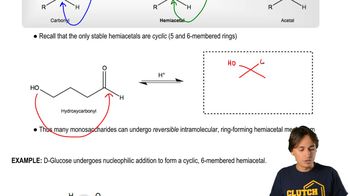
Recognize that the formation of a cyclic hemiacetal involves an intramolecular reaction between the hydroxyl group and the carbonyl group of the aldehyde. The hydroxyl group acts as a nucleophile, attacking the electrophilic carbon of the aldehyde group.
Count the number of atoms in the ring that will form. Since the hydroxyl group is on C5 and the aldehyde is on C1, the reaction will form a six-membered ring (including the oxygen atom). This is because the chain between C1 and C5 includes four carbons and one oxygen.
Draw the structure of the cyclic hemiacetal. The oxygen from the hydroxyl group will be part of the ring, and the carbonyl carbon (C1) will now have a single bond to the oxygen, forming a hydroxyl group (-OH) at C1. Ensure the stereochemistry is correct, as the new chiral center at C1 can have two possible configurations.

Risposta video verificata per un problema simile:

Questa soluzione video è stata consigliata dai nostri tutor come utile per risolvere questo problema.
Durata del video:
4m

Concetti chiave

Ecco i concetti essenziali che devi comprendere per rispondere correttamente alla domanda.

Hemiacetals

Hemiacetals are organic compounds formed when an aldehyde or ketone reacts with an alcohol. They contain one hydroxyl group (-OH) and one alkoxy group (-O-R) attached to the same carbon atom, which is typically derived from the carbonyl carbon. In the case of sugars, hemiacetals are crucial as they represent the cyclic forms of monosaccharides, where the carbonyl carbon forms a bond with a hydroxyl group from the same molecule.
Video consigliato:
06:23
Monosaccharides - Forming Cyclic Hemiacetals

Cyclic Structures

Cyclic structures in organic chemistry refer to molecules that form a closed loop or ring. In the context of hemiacetals, the formation of a cyclic structure occurs when the hydroxyl group of an alcohol reacts with the carbonyl carbon of an aldehyde, leading to the creation of a five- or six-membered ring. This cyclic form is often more stable than its open-chain counterpart, influencing the reactivity and properties of the compound.
Video consigliato:
06:23
Monosaccharides - Forming Cyclic Hemiacetals

Hydroxyl Groups

Hydroxyl groups (-OH) are functional groups consisting of an oxygen atom bonded to a hydrogen atom. They are polar and can form hydrogen bonds, which significantly affect the solubility and reactivity of organic compounds. In the case of 5-hydroxypentanal, the presence of the hydroxyl group allows for the formation of a cyclic hemiacetal, as it can interact with the aldehyde group to create a stable ring structure.
Video consigliato:
04:42
Sequence Groups