Ch. 20 - The Organic Chemistry of Carbohydrates
Bruice - Organic Chemistry 8th Edition
Bruice8th EditionOrganic ChemistryISBN: 9780135213711Non è quello che usi tu?Cambia libro di testo
Capitolo 20, Problema 19d

4-Hydroxy- and 5-hydroxyaldehydes exist primarily as cyclic hemiacetals. Draw the structure of the cyclic hemiacetal formed by each of the following:
d. 4-hydroxyheptanal

Guida verificata passo dopo passo
1
Identify the functional groups in 4-hydroxyheptanal: it contains both an aldehyde (-CHO) group and a hydroxyl (-OH) group. The aldehyde is at the first carbon, and the hydroxyl group is at the fourth carbon.
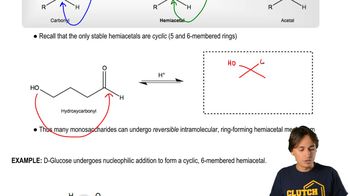
Understand the concept of hemiacetal formation: A hemiacetal is formed when an alcohol (-OH) reacts with an aldehyde (-CHO) within the same molecule, resulting in a cyclic structure. This occurs through an intramolecular nucleophilic addition reaction.
Determine the ring size: The hydroxyl group on carbon 4 can react with the aldehyde group on carbon 1. Counting the chain from carbon 1 to carbon 4, this forms a six-membered ring (including the oxygen atom). Six-membered rings are generally stable due to minimal ring strain.
Draw the mechanism of the reaction: The lone pair of electrons on the oxygen atom of the hydroxyl group attacks the carbonyl carbon of the aldehyde group. This forms a new C-O bond, and the carbonyl oxygen becomes protonated, resulting in the cyclic hemiacetal.
Draw the final structure: Represent the six-membered ring with the oxygen atom as part of the ring. Show the hydroxyl group (from the hemiacetal) attached to the former carbonyl carbon, and ensure all substituents (e.g., alkyl groups) are correctly positioned on the ring.

Risposta video verificata per un problema simile:

Questa soluzione video è stata consigliata dai nostri tutor come utile per risolvere questo problema.
Durata del video:
5m

Concetti chiave

Ecco i concetti essenziali che devi comprendere per rispondere correttamente alla domanda.

Hemiacetals

Hemiacetals are organic compounds formed from the reaction of an aldehyde or ketone with an alcohol. In the case of 4-hydroxyheptanal, the hydroxyl group at the fourth carbon can react with the carbonyl group at the first carbon, leading to the formation of a cyclic hemiacetal. This reaction is crucial in understanding the structure and stability of sugars and other carbohydrates.
Video consigliato:
06:23
Monosaccharides - Forming Cyclic Hemiacetals

Cyclic Structures

Cyclic structures are formed when a molecule folds back on itself to create a ring. In the context of hemiacetals, the formation of a cyclic structure often stabilizes the molecule, making it more favorable than its open-chain form. For 4-hydroxyheptanal, the cyclic hemiacetal structure is a result of intramolecular interactions that minimize steric hindrance and maximize stability.
Video consigliato:
06:23
Monosaccharides - Forming Cyclic Hemiacetals

Stereochemistry

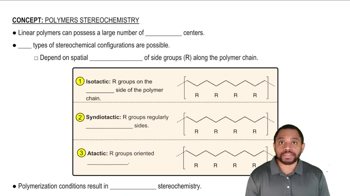
Stereochemistry refers to the study of the spatial arrangement of atoms in molecules and how this affects their chemical behavior. In cyclic hemiacetals, the stereochemistry at the anomeric carbon (the carbon derived from the carbonyl) is particularly important, as it can lead to different isomers. Understanding stereochemistry is essential for predicting the reactivity and properties of the cyclic hemiacetal formed from 4-hydroxyheptanal.
Video consigliato:
Percorso guidato
1:38
Polymer Stereochemistry Concept 1