Ch. 20 - The Organic Chemistry of Carbohydrates
Bruice - Organic Chemistry 8th Edition
Bruice8th EditionOrganic ChemistryISBN: 9780135213711Non è quello che usi tu?Cambia libro di testo
Capitolo 20, Problema 31a

What is the main structural difference between a. amylose and cellulose?

Guida verificata passo dopo passo
1
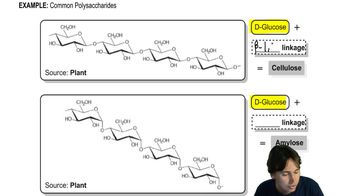
Step 1: Understand the structure of amylose. Amylose is a polysaccharide composed of α-D-glucose units linked by α(1→4) glycosidic bonds, forming a linear chain.
Step 2: Understand the structure of cellulose. Cellulose is also a polysaccharide, but it is composed of β-D-glucose units linked by β(1→4) glycosidic bonds, forming a linear chain. The β-linkages result in a more rigid structure compared to amylose.
Step 3: Compare amylose and cellulose. The main structural difference lies in the type of glycosidic bond: amylose has α(1→4) linkages, while cellulose has β(1→4) linkages. This difference affects their physical properties and biological roles.
Step 4: Understand the structure of amylopectin. Amylopectin is a branched polysaccharide composed of α-D-glucose units. It has α(1→4) glycosidic bonds in the linear portions and α(1→6) glycosidic bonds at the branch points.
Step 5: Compare amylose and amylopectin. The main structural difference is that amylose is linear, while amylopectin is branched due to the presence of α(1→6) linkages at the branch points.

Risposta video verificata per un problema simile:

Questa soluzione video è stata consigliata dai nostri tutor come utile per risolvere questo problema.
Durata del video:
8m

Concetti chiave

Ecco i concetti essenziali che devi comprendere per rispondere correttamente alla domanda.

Polysaccharide Structure

Polysaccharides are large carbohydrate molecules composed of long chains of monosaccharide units. The structural differences among polysaccharides like amylose, cellulose, and amylopectin arise from the types of glycosidic bonds and the branching of the chains. Understanding these structures is crucial for distinguishing their functions and properties in biological systems.
Video consigliato:
11:53
Polysaccharide

Glycosidic Bonds

Glycosidic bonds are covalent linkages formed between monosaccharides through a dehydration reaction. In amylose, the glucose units are connected by α(1→4) glycosidic bonds, resulting in a linear structure. In contrast, cellulose consists of β(1→4) glycosidic bonds, leading to a rigid, linear arrangement that contributes to its structural role in plant cell walls.
Video consigliato:
06:00
Single bonds, double bonds, and triple bonds.

Branching in Polysaccharides

Branching refers to the presence of side chains in polysaccharide structures. Amylopectin, a component of starch, has both α(1→4) and α(1→6) glycosidic bonds, creating a highly branched structure that allows for rapid energy release. In contrast, amylose is predominantly unbranched, affecting its solubility and digestibility compared to amylopectin.
Video consigliato:
11:53
Polysaccharide