Ch. 20 - The Organic Chemistry of Carbohydrates
Bruice - Organic Chemistry 8th Edition
Bruice8th EditionOrganic ChemistryISBN: 9780135213711Non è quello che usi tu?Cambia libro di testo
Capitolo 20, Problema 31c

What is the main structural difference between c. amylopectin and glycogen?

Guida verificata passo dopo passo
1
Amylopectin and glycogen are both branched polysaccharides, but the main structural difference lies in the degree of branching. Amylopectin has branches approximately every 24-30 glucose units, while glycogen has branches more frequently, approximately every 8-12 glucose units. This makes glycogen more compact and highly branched compared to amylopectin.
Cellulose and chitin are both linear polysaccharides, but the main structural difference is in the monomer units and the functional groups attached. Cellulose is composed of β-D-glucose monomers linked by β(1→4) glycosidic bonds, while chitin is composed of N-acetylglucosamine (a derivative of glucose) monomers linked by β(1→4) glycosidic bonds.
In cellulose, the hydroxyl groups (-OH) on the glucose monomers allow for extensive hydrogen bonding between adjacent chains, giving cellulose its high tensile strength and rigidity.
In chitin, the presence of the N-acetyl group (-NHCOCH₃) on the glucose derivative provides additional hydrogen bonding opportunities, making chitin structurally similar to cellulose but with slightly different properties, such as increased rigidity and resistance to degradation.
To summarize, the key differences are the branching frequency in amylopectin versus glycogen, and the monomer composition (glucose vs. N-acetylglucosamine) and functional groups in cellulose versus chitin.

Risposta video verificata per un problema simile:

Questa soluzione video è stata consigliata dai nostri tutor come utile per risolvere questo problema.
Durata del video:
6m

Concetti chiave

Ecco i concetti essenziali che devi comprendere per rispondere correttamente alla domanda.

Amylopectin vs. Glycogen

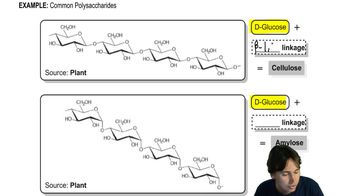
Amylopectin and glycogen are both polysaccharides composed of glucose units, but they differ in structure and function. Amylopectin, found in plants, has a branched structure with fewer branches compared to glycogen, which is highly branched and serves as a primary energy storage molecule in animals. The branching in glycogen allows for rapid mobilization of glucose when energy is needed.
Video consigliato:
03:06
1,2 vs. 1,4 products

Cellulose vs. Chitin

Cellulose and chitin are both structural polysaccharides, but they are composed of different monomers and serve different organisms. Cellulose is made of β-glucose units and is a key component of plant cell walls, providing rigidity. In contrast, chitin is composed of N-acetylglucosamine units and is found in the exoskeletons of arthropods and the cell walls of fungi, offering strength and protection.
Video consigliato:
03:06
1,2 vs. 1,4 products

Polysaccharide Structure and Function

Polysaccharides are long chains of monosaccharides linked by glycosidic bonds, and their structure directly influences their function. The arrangement of these sugar units, including branching and types of glycosidic linkages, determines whether a polysaccharide serves as an energy storage molecule or a structural component. Understanding these structural differences is crucial for distinguishing between various polysaccharides like amylopectin, glycogen, cellulose, and chitin.
Video consigliato:
11:53
Polysaccharide