Ch. 21 - Amino Acids, Peptides, and Proteins
Bruice - Organic Chemistry 8th Edition
Bruice8th EditionOrganic ChemistryISBN: 9780135213711Non è quello che usi tu?Cambia libro di testo
Capitolo 21, Problema 74

Dithiothreitol reacts with disulfide bridges in the same way that 2-mercaptoethanol does. With dithiothreitol, however, the equilibrium lies much more to the right. Explain.

Guida verificata passo dopo passo
1
Dithiothreitol (DTT) contains two thiol (-SH) groups that can react with disulfide bridges (RSSR) in proteins or other molecules. The reaction involves the reduction of the disulfide bond to two thiol groups (RSH) while DTT itself forms a cyclic disulfide.
The equilibrium of this reaction lies more to the right (favoring the products) because the formation of the cyclic disulfide in DTT is highly thermodynamically favorable. This is due to the stability of the five-membered ring formed in the product.
The five-membered ring in the oxidized form of DTT is stabilized by its geometry and intramolecular interactions, which lowers the energy of the product and shifts the equilibrium toward the right.
In contrast, 2-mercaptoethanol does not form a cyclic disulfide upon oxidation. Instead, it forms a linear disulfide, which is less stable compared to the cyclic disulfide of DTT. This makes the equilibrium for 2-mercaptoethanol less favorable toward the products.
Thus, the higher thermodynamic stability of the cyclic disulfide product in DTT explains why the equilibrium lies much more to the right compared to 2-mercaptoethanol.

Risposta video verificata per un problema simile:

Questa soluzione video è stata consigliata dai nostri tutor come utile per risolvere questo problema.
Durata del video:
6m

Concetti chiave

Ecco i concetti essenziali che devi comprendere per rispondere correttamente alla domanda.

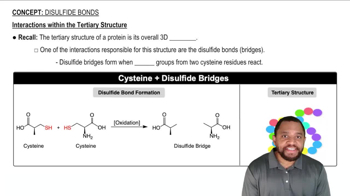
Disulfide Bridges

Disulfide bridges are covalent bonds formed between the sulfur atoms of two cysteine residues in proteins. These bonds play a crucial role in stabilizing the three-dimensional structure of proteins. The reduction of disulfide bridges can lead to the unfolding of proteins, affecting their function.
Video consigliato:
Percorso guidato
1:34
Disulfide Bonds Concept 2

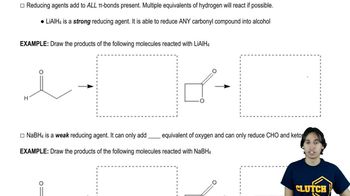
Reducing Agents

Reducing agents are substances that donate electrons to other compounds, thereby reducing their oxidation state. In the context of disulfide bridges, reducing agents like dithiothreitol (DTT) and 2-mercaptoethanol break these bonds by providing electrons, converting disulfides back to free thiols. The effectiveness of a reducing agent is often determined by its ability to shift the equilibrium of the reaction.
Video consigliato:
09:28
Reducing Agents

Equilibrium in Chemical Reactions

Equilibrium in chemical reactions refers to the state where the rates of the forward and reverse reactions are equal, resulting in constant concentrations of reactants and products. In the case of DTT, its ability to shift the equilibrium further to the right indicates a stronger tendency to reduce disulfide bridges compared to 2-mercaptoethanol, making it a more effective reducing agent in biological systems.
Video consigliato:
Percorso guidato
3:11
Chemical Reactions of Phosphate Anhydrides Concept 1