Ch. 21 - Amino Acids, Peptides, and Proteins
Bruice - Organic Chemistry 8th Edition
Bruice8th EditionOrganic ChemistryISBN: 9780135213711Non è quello che usi tu?Cambia libro di testo
Capitolo 21, Problema 75d

Show how valine can be prepared by
d. a N-phthalimidomalonic ester synthesis. 

Guida verificata passo dopo passo
1
Step 1: Understand the N-phthalimidomalonic ester synthesis. This method involves the use of diethyl malonate, phthalimide, and a suitable alkyl halide to synthesize α-amino acids. The phthalimide group protects the amine functionality during the reaction.
Step 2: Start with the N-phthalimidomalonic ester. This compound is prepared by reacting diethyl malonate with phthalimide in the presence of a base such as potassium carbonate (K₂CO₃).
Step 3: Perform the alkylation step. Treat the N-phthalimidomalonic ester with isopropyl bromide (CH₃-CHBr-CH₃) in the presence of a strong base like sodium ethoxide (NaOEt). This step introduces the isopropyl group, which is the side chain of valine.
Step 4: Hydrolyze and decarboxylate. Hydrolyze the ester groups using aqueous acid or base to form the corresponding dicarboxylic acid. Then, heat the compound to decarboxylate one of the carboxylic acid groups, forming the intermediate α-amino acid with the phthalimide group still attached.
Step 5: Remove the phthalimide protecting group. Treat the intermediate with hydrazine (NH₂NH₂) to remove the phthalimide group, yielding valine as the final product.

Risposta video verificata per un problema simile:

Questa soluzione video è stata consigliata dai nostri tutor come utile per risolvere questo problema.
Durata del video:
3m

Concetti chiave

Ecco i concetti essenziali che devi comprendere per rispondere correttamente alla domanda.

N-phthalimidomalonic Ester Synthesis

N-phthalimidomalonic ester synthesis is a method used to synthesize amino acids, particularly through the reaction of phthalimide with malonic ester. This reaction involves the formation of a phthalimide derivative that can undergo hydrolysis and decarboxylation to yield the desired amino acid. The process is notable for its ability to introduce a side chain to the amino acid, making it a valuable tool in organic synthesis.
Video consigliato:
Percorso guidato
2:21
Synthesis of Amino Acids: N-Phthalimidomalonic Ester Synthesis Example 2

Valine Structure and Properties

Valine is an essential branched-chain amino acid characterized by its isopropyl side chain. It plays a crucial role in protein synthesis and is important for muscle metabolism and tissue repair. Understanding valine's structure helps in recognizing how it can be synthesized through various organic reactions, including the N-phthalimidomalonic ester synthesis.
Video consigliato:
Percorso guidato
1:19
Polymers Structure and Properties Concept 1

Decarboxylation in Organic Synthesis

Decarboxylation is a chemical reaction that involves the removal of a carboxyl group from a molecule, releasing carbon dioxide. In the context of amino acid synthesis, decarboxylation is often a key step that transforms intermediates into the final amino acid product. This reaction is essential for converting malonic acid derivatives into amino acids like valine, as it helps in forming the correct carbon skeleton.
Video consigliato:
Percorso guidato
3:33
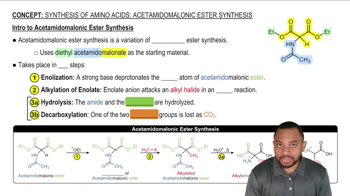
Synthesis of Amino Acids: Acetamidomalonic Ester Synthesis Concept 1