Ch. 21 - Amino Acids, Peptides, and Proteins
Bruice - Organic Chemistry 8th Edition
Bruice8th EditionOrganic ChemistryISBN: 9780135213711Non è quello che usi tu?Cambia libro di testo
Capitolo 21, Problema 34

Show the steps in the synthesis of the tetrapeptide Leu-Phe-Ala-Val.

Guida verificata passo dopo passo
1
Step 1: Protect the amino group of the first amino acid (Leucine) using a protecting group such as tert-butyloxycarbonyl (Boc) to prevent unwanted reactions. This forms Boc-Leu.
Step 2: Activate the carboxyl group of the second amino acid (Phenylalanine) using a coupling reagent like dicyclohexylcarbodiimide (DCC) or HATU. This allows the formation of a peptide bond. React Boc-Leu with activated Phe to form Boc-Leu-Phe.
Step 3: Deprotect the Boc group from Boc-Leu-Phe using an acid such as trifluoroacetic acid (TFA) to expose the free amino group. This gives Leu-Phe with a free amino group.
Step 4: Repeat the process for the next amino acid (Alanine). Protect the amino group of Alanine with Boc, activate its carboxyl group, and couple it with the free amino group of Leu-Phe. This forms Boc-Leu-Phe-Ala.
Step 5: Finally, deprotect the Boc group from Boc-Leu-Phe-Ala and couple it with the activated Valine (using the same activation and coupling strategy). This results in the tetrapeptide Leu-Phe-Ala-Val.

Risposta video verificata per un problema simile:

Questa soluzione video è stata consigliata dai nostri tutor come utile per risolvere questo problema.
Durata del video:
9m

Concetti chiave

Ecco i concetti essenziali che devi comprendere per rispondere correttamente alla domanda.

Peptide Synthesis

Peptide synthesis involves the formation of peptide bonds between amino acids to create peptides. This process typically follows the stepwise addition of protected amino acids, where the carboxyl group of one amino acid reacts with the amino group of another, releasing water. Understanding the mechanisms of peptide bond formation is crucial for synthesizing specific sequences like tetrapeptides.
Video consigliato:
Percorso guidato
1:53
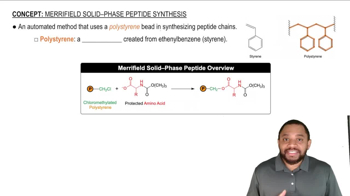
Merrifield Solid-Phase Peptide Synthesis Concept 1

Amino Acid Protection

In peptide synthesis, protecting groups are used to prevent unwanted reactions at the functional groups of amino acids. For example, the amino group can be protected with a group like Fmoc or Boc, allowing for selective coupling of amino acids in a desired sequence. Mastery of protection and deprotection strategies is essential for successful synthesis.
Video consigliato:
09:36
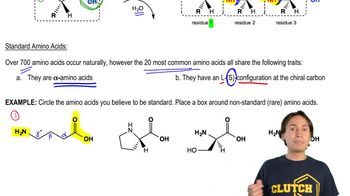
Standard Amino Acids

Solid-Phase Peptide Synthesis (SPPS)

Solid-phase peptide synthesis (SPPS) is a widely used method for synthesizing peptides, where the growing peptide chain is anchored to a solid resin. This technique allows for easy washing and purification of intermediates, facilitating the stepwise addition of amino acids. Understanding SPPS is vital for efficiently synthesizing complex peptides like Leu-Phe-Ala-Val.
Video consigliato:
Percorso guidato
1:53
Merrifield Solid-Phase Peptide Synthesis Concept 1