Ch. 21 - Amino Acids, Peptides, and Proteins
Bruice - Organic Chemistry 8th Edition
Bruice8th EditionOrganic ChemistryISBN: 9780135213711Non è quello che usi tu?Cambia libro di testo
Capitolo 21, Problema 32

What dipeptides would be formed by heating a mixture of valine and N-protected leucine?

Guida verificata passo dopo passo
1
Step 1: Understand the problem. A dipeptide is formed when two amino acids are joined by a peptide bond. In this case, the amino acids are valine (Val) and N-protected leucine (Leu). The N-protection on leucine prevents its amino group from participating in the reaction, so only its carboxyl group can react.
Step 2: Identify the functional groups involved. Valine has both an amino group (-NH₂) and a carboxyl group (-COOH) available for reaction. N-protected leucine has its amino group blocked, leaving only its carboxyl group (-COOH) available for reaction.
Step 3: Determine the possible reaction pathways. The peptide bond can form in two ways: (1) the amino group of valine reacts with the carboxyl group of N-protected leucine, forming Val-Leu (N-protected), or (2) the carboxyl group of valine reacts with the amino group of N-protected leucine, forming Leu-Val (N-protected).
Step 4: Write the chemical structures of the dipeptides. For Val-Leu, the structure will have valine at the N-terminus and N-protected leucine at the C-terminus. For Leu-Val, the structure will have N-protected leucine at the N-terminus and valine at the C-terminus. Use MathML to represent the structures if needed.
Step 5: Conclude that heating the mixture of valine and N-protected leucine can result in the formation of two dipeptides: Val-Leu (N-protected) and Leu-Val (N-protected), depending on the direction of the peptide bond formation.

Risposta video verificata per un problema simile:

Questa soluzione video è stata consigliata dai nostri tutor come utile per risolvere questo problema.
Durata del video:
4m

Concetti chiave

Ecco i concetti essenziali che devi comprendere per rispondere correttamente alla domanda.

Dipeptides

Dipeptides are organic compounds formed by the condensation of two amino acids, linked by a peptide bond. This bond is created when the carboxyl group of one amino acid reacts with the amino group of another, releasing a molecule of water. Understanding the structure and formation of dipeptides is essential for predicting the products of amino acid reactions.
Video consigliato:
Percorso guidato
2:27
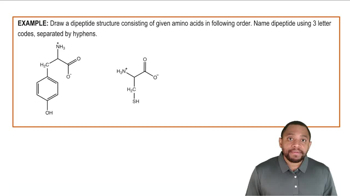
Peptides Example 2

Amino Acid Structure

Amino acids are the building blocks of proteins, each consisting of a central carbon atom bonded to an amino group, a carboxyl group, a hydrogen atom, and a variable side chain (R group). The side chains determine the properties and identity of the amino acids, such as valine and leucine. Recognizing the specific structures of these amino acids is crucial for understanding how they interact and form dipeptides.
Video consigliato:
7:19
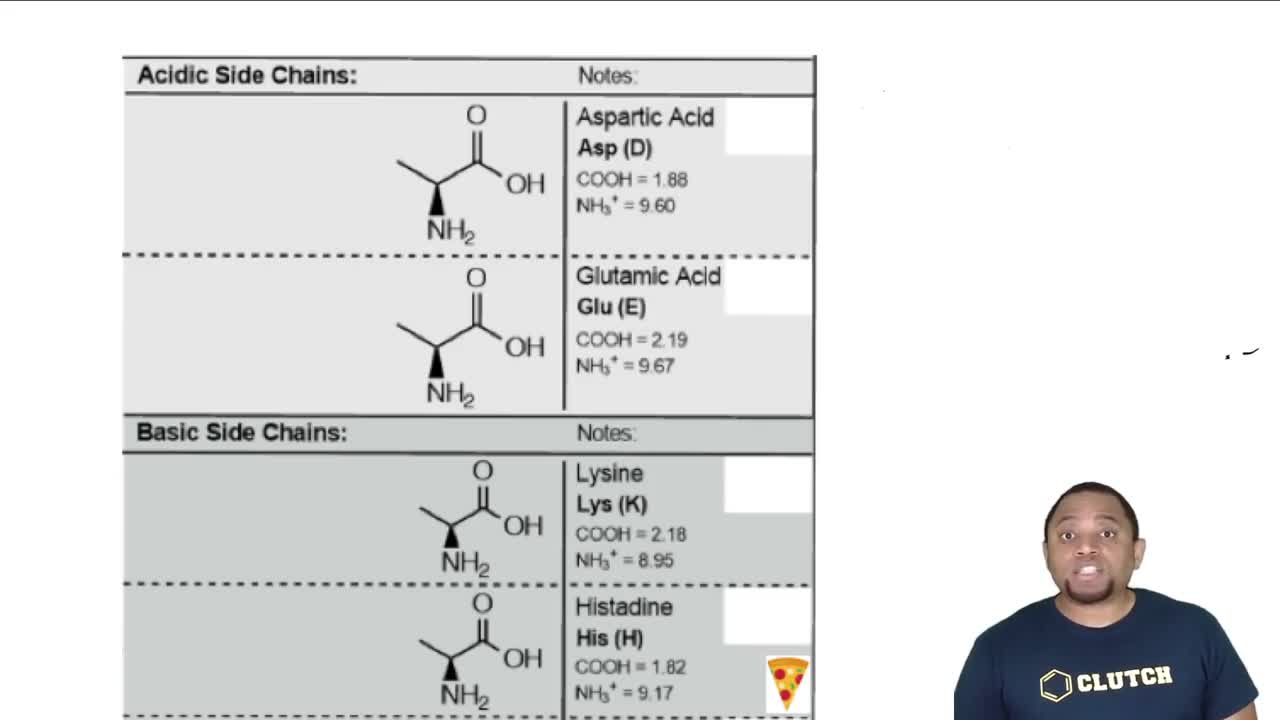
Charged Amino Acids

N-protection in Amino Acids

N-protection refers to the modification of the amino group in an amino acid to prevent it from participating in unwanted reactions during peptide synthesis. This is often achieved using protecting groups that can be removed later. In the context of the question, knowing how N-protected leucine behaves when heated with valine is vital for predicting the resulting dipeptides.
Video consigliato:
Percorso guidato
3:06
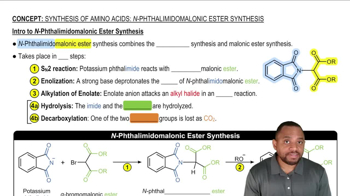
Synthesis of Amino Acids: N-Phthalimidomalonic Ester Synthesis Concept 1