Ch. 3 - An Introduction to Organic Compounds: Nomenclature, Physical Properties, and Structure
Bruice - Organic Chemistry 8th Edition
Bruice8th EditionOrganic ChemistryISBN: 9780135213711Non è quello che usi tu?Cambia libro di testo
Capitolo 3, Problema 12b

Give each isomer its systematic name.

Guida verificata passo dopo passo
1
Step 1: Identify the functional group(s) present in each isomer. Functional groups determine the suffix or prefix of the systematic name. For example, alcohols (-OH) use the suffix '-ol', while ketones (-C=O) use the suffix '-one'.
Step 2: Determine the longest continuous carbon chain in each isomer that includes the functional group. This chain will serve as the parent chain, and its length determines the root name (e.g., 'meth-', 'eth-', 'prop-', etc.).
Step 3: Number the carbon atoms in the parent chain, starting from the end closest to the functional group. This ensures the functional group gets the lowest possible number.
Step 4: Identify and name any substituents (e.g., alkyl groups, halogens) attached to the parent chain. Assign a number to each substituent based on its position on the parent chain.
Step 5: Combine the information into the systematic name by arranging substituents in alphabetical order, followed by the parent chain name and the suffix for the functional group. Use hyphens to separate numbers from words and commas to separate numbers.

Risposta video verificata per un problema simile:

Questa soluzione video è stata consigliata dai nostri tutor come utile per risolvere questo problema.
Durata del video:
5m

Concetti chiave

Ecco i concetti essenziali che devi comprendere per rispondere correttamente alla domanda.

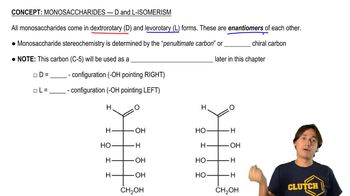
Isomerism

Isomerism refers to the phenomenon where two or more compounds have the same molecular formula but different structural arrangements or spatial orientations. This can lead to variations in physical and chemical properties. Understanding isomerism is crucial for naming compounds systematically, as different isomers can have distinct names based on their structure.
Video consigliato:
06:47
Monosaccharides - D and L Isomerism

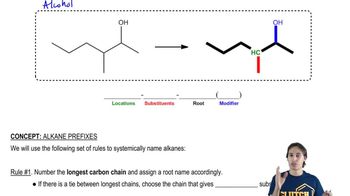
Systematic Naming

Systematic naming, often guided by the IUPAC (International Union of Pure and Applied Chemistry) rules, provides a standardized method for naming chemical compounds. This involves identifying the longest carbon chain, functional groups, and the position of substituents. Mastery of these rules is essential for accurately naming isomers and communicating chemical information effectively.
Video consigliato:
03:43
The different parts of an IUPAC name

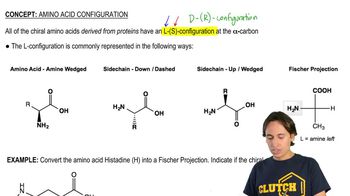
Structural Representation

Structural representation involves depicting the arrangement of atoms within a molecule, which is vital for distinguishing between isomers. Common representations include Lewis structures, condensed formulas, and skeletal formulas. A clear understanding of these representations helps in visualizing the differences between isomers, which is necessary for their correct systematic naming.
Video consigliato:
05:09
Representations of L-Configuration