Ch. 3 - An Introduction to Organic Compounds: Nomenclature, Physical Properties, and Structure
Bruice - Organic Chemistry 8th Edition
Bruice8th EditionOrganic ChemistryISBN: 9780135213711Non è quello che usi tu?Cambia libro di testo
Capitolo 3, Problema 11e

Draw the structure for each of the following:
e. 2,5-dimethyl-4-(2-methylpropyl)octane

Guida verificata passo dopo passo
1
Step 1: Start by identifying the parent chain. The parent chain is 'octane,' which means it is a straight chain of 8 carbon atoms. Draw a linear chain of 8 carbons.
Step 2: Number the carbon atoms in the parent chain from 1 to 8. Numbering should be done in such a way that the substituents get the lowest possible numbers.
Step 3: Add the substituents to the parent chain. The name '2,5-dimethyl' indicates that there are methyl groups (-CH₃) attached to carbons 2 and 5 of the parent chain. Draw these methyl groups at the appropriate positions.
Step 4: Add the '4-(2-methylpropyl)' substituent. This indicates that at carbon 4 of the parent chain, there is a 2-methylpropyl group. A 2-methylpropyl group consists of a three-carbon chain with a methyl group attached to the second carbon. Attach this group to carbon 4 of the parent chain.
Step 5: Verify the structure. Ensure that all carbons have four bonds, all substituents are correctly placed, and the structure matches the IUPAC name '2,5-dimethyl-4-(2-methylpropyl)octane.'

Risposta video verificata per un problema simile:

Questa soluzione video è stata consigliata dai nostri tutor come utile per risolvere questo problema.
Durata del video:
1m

Concetti chiave

Ecco i concetti essenziali che devi comprendere per rispondere correttamente alla domanda.

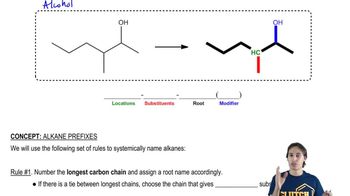
IUPAC Nomenclature

IUPAC nomenclature is a systematic method for naming organic chemical compounds. It provides rules for identifying the structure of a compound based on its name, including the longest carbon chain, substituents, and their positions. Understanding these rules is essential for accurately interpreting the name '2,5-dimethyl-4-(2-methylpropyl)octane' and constructing its corresponding structure.
Video consigliato:
03:43
The different parts of an IUPAC name

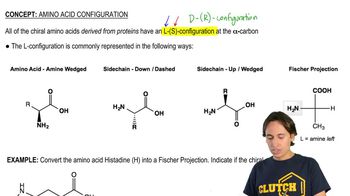
Structural Representation

Structural representation in organic chemistry involves depicting the arrangement of atoms within a molecule. This can be done using various formats, such as Lewis structures, condensed formulas, or skeletal structures. For the compound in question, drawing the correct structural representation requires recognizing the branching and substituents indicated by the name.
Video consigliato:
05:09
Representations of L-Configuration

Isomerism

Isomerism refers to the phenomenon where compounds have the same molecular formula but different structural arrangements or spatial orientations. In the case of '2,5-dimethyl-4-(2-methylpropyl)octane', understanding isomerism is important to ensure that the correct structure is drawn, as different arrangements can lead to different physical and chemical properties.
Video consigliato:
06:47
Monosaccharides - D and L Isomerism