Ch. 3 - An Introduction to Organic Compounds: Nomenclature, Physical Properties, and Structure
Bruice - Organic Chemistry 8th Edition
Bruice8th EditionOrganic ChemistryISBN: 9780135213711Non è quello che usi tu?Cambia libro di testo
Capitolo 3, Problema 14c

Draw the structure and give the systematic name for a compound with molecular formula C5H12 that has
(c) one tertiary hydrogen

Guida verificata passo dopo passo
1
Step 1: Understand the problem. The molecular formula C5H12 corresponds to an alkane (a saturated hydrocarbon). The problem specifies that the compound must have one tertiary hydrogen. A tertiary hydrogen is a hydrogen atom attached to a carbon that is itself bonded to three other carbons.
Step 2: Identify possible structures for C5H12. Since it is an alkane, the structure must follow the general formula CnH2n+2. For C5H12, there are three possible isomers: n-pentane, isopentane (2-methylbutane), and neopentane (2,2-dimethylpropane).
Step 3: Determine which structure contains a tertiary hydrogen. A tertiary hydrogen is only present in a structure where a carbon is bonded to three other carbons. Analyze each isomer: n-pentane has no tertiary carbons, neopentane has no tertiary hydrogens, but 2-methylbutane has one tertiary hydrogen on the central carbon.
Step 4: Draw the structure of 2-methylbutane. Start with a four-carbon chain (butane) and add a methyl group (-CH3) to the second carbon. Ensure that the structure satisfies the molecular formula C5H12 and includes one tertiary hydrogen.
Step 5: Provide the systematic name. The compound is named 2-methylbutane because the longest continuous chain has four carbons (butane), and a methyl group is attached to the second carbon. Verify that the structure matches the requirements of the problem.

Risposta video verificata per un problema simile:

Questa soluzione video è stata consigliata dai nostri tutor come utile per risolvere questo problema.
Durata del video:
3m

Concetti chiave

Ecco i concetti essenziali che devi comprendere per rispondere correttamente alla domanda.

Tertiary Hydrogen

A tertiary hydrogen is a hydrogen atom that is attached to a carbon atom, which in turn is bonded to three other carbon atoms. In organic chemistry, identifying tertiary hydrogens is crucial for understanding the reactivity and stability of molecules, particularly in reactions involving free radicals or carbocation formation.
Video consigliato:
Percorso guidato
2:07
Tertiary Protein Structure Concept 1

Molecular Formula and Structure

The molecular formula C5H12 indicates that the compound contains five carbon atoms and twelve hydrogen atoms. This formula suggests that the compound is likely a saturated hydrocarbon, specifically an alkane, which can be represented by various structural isomers. Drawing the correct structure is essential for determining the compound's properties and systematic name.
Video consigliato:
02:17
How to use IHD with molecular formula.

Systematic Naming (IUPAC Nomenclature)

IUPAC nomenclature is a standardized system for naming chemical compounds based on their structure. For alkanes, the name is derived from the longest continuous carbon chain, with prefixes indicating the number of carbons and suffixes denoting the type of compound. Understanding this system is vital for accurately naming the compound with the given molecular formula and structural characteristics.
Video consigliato:
03:43
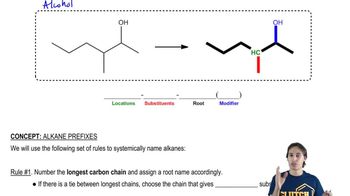
The different parts of an IUPAC name