Ch. 3 - An Introduction to Organic Compounds: Nomenclature, Physical Properties, and Structure
Bruice - Organic Chemistry 8th Edition
Bruice8th EditionOrganic ChemistryISBN: 9780135213711Non è quello che usi tu?Cambia libro di testo
Capitolo 3, Problema 15g,h

What is each compound's systematic name?
g. Structural representation of an alkyl group with carbon chains and branching.
h. Structural representation of an alkyl group with a hexagonal ring and branching chains.

Guida verificata passo dopo passo
1
Step 1: Analyze the structure in (i). Identify the longest continuous carbon chain as the parent chain. Count the number of carbons in this chain to determine the base name of the compound.
Step 2: Identify and name the substituents attached to the parent chain in (i). Assign locants (numbers) to the substituents based on the position on the parent chain, ensuring the lowest possible numbers are used.
Step 3: Combine the substituent names with the parent chain name in (i), following IUPAC nomenclature rules. Use hyphens to separate numbers from names and commas to separate multiple numbers.
Step 4: Analyze the structure in (ii). Identify the cyclohexane ring as the parent structure. Count the carbons in the ring to confirm it is a six-membered ring.
Step 5: Identify and name the substituents attached to the cyclohexane ring in (ii). Assign locants to the substituents, ensuring the lowest possible numbers are used. Combine the substituent names with the parent name, following IUPAC rules.

Risposta video verificata per un problema simile:

Questa soluzione video è stata consigliata dai nostri tutor come utile per risolvere questo problema.
Durata del video:
2m

Concetti chiave

Ecco i concetti essenziali che devi comprendere per rispondere correttamente alla domanda.

Systematic Naming in Organic Chemistry

Systematic naming, or IUPAC nomenclature, is a standardized method for naming organic compounds based on their structure. It involves identifying the longest carbon chain, determining the functional groups, and assigning locants to indicate the position of substituents. This systematic approach ensures that each compound has a unique name that reflects its molecular structure.
Video consigliato:
00:56
What is an organic molecule?

Alkyl Groups

Alkyl groups are derived from alkanes by removing one hydrogen atom, resulting in a substituent that can attach to a larger molecule. They are characterized by their carbon chain length and branching, which influence the compound's properties. Common alkyl groups include methyl (C1), ethyl (C2), and propyl (C3), and their systematic naming is crucial for accurately describing organic compounds.
Video consigliato:
03:19
Sodium Alkynide Alkylation

Cycloalkanes

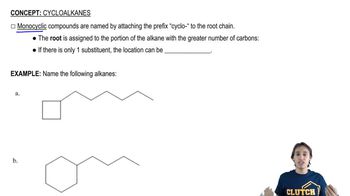
Cycloalkanes are a class of hydrocarbons that contain carbon atoms arranged in a ring structure. They can be saturated (single bonds only) or unsaturated (containing double bonds). The systematic naming of cycloalkanes involves identifying the ring size and substituents, which is essential for distinguishing them from linear alkanes and understanding their chemical behavior.
Video consigliato:
01:11
How to find the root name for cycloalkanes