Ch. 7 - The Reactions of Alkynes • An Introduction to Multistep Synthesis
Bruice - Organic Chemistry 8th Edition
Bruice8th EditionOrganic ChemistryISBN: 9780135213711Non è quello che usi tu?Cambia libro di testo
Capitolo 7, Problema 40g

Answer Problem 39, parts a–h, using 2-butyne as the starting material instead of propyne.
g. excess H2, Pd/C

Guida verificata passo dopo passo
1
Identify the starting material: The starting material is 2-butyne, which is an alkyne with the structure CH3-C≡C-CH3. It contains a triple bond between the second and third carbons.
Understand the reaction conditions: The reaction involves excess H2 (hydrogen gas) and Pd/C (palladium on carbon), which is a catalyst used for hydrogenation reactions. Excess H2 ensures complete hydrogenation of the alkyne.
Determine the reaction type: This is a catalytic hydrogenation reaction. In the presence of Pd/C and excess H2, the alkyne will undergo complete hydrogenation, converting the triple bond into a single bond by adding hydrogen atoms.
Write the reaction mechanism: The triple bond in 2-butyne will first be reduced to a double bond (alkene) by the addition of two hydrogen atoms. Then, the double bond will be further reduced to a single bond (alkane) by the addition of two more hydrogen atoms. The final product will be an alkane.
Predict the product: The complete hydrogenation of 2-butyne will result in butane (CH3-CH2-CH2-CH3), as all π bonds in the alkyne are replaced with σ bonds by the addition of hydrogen atoms.

Risposta video verificata per un problema simile:

Questa soluzione video è stata consigliata dai nostri tutor come utile per risolvere questo problema.
Durata del video:
3m

Concetti chiave

Ecco i concetti essenziali che devi comprendere per rispondere correttamente alla domanda.

Alkyne Hydrogenation

Hydrogenation of alkynes involves the addition of hydrogen (H2) across the triple bond, converting it into an alkene or alkane. In the presence of a catalyst like palladium on carbon (Pd/C), this reaction can proceed efficiently. For 2-butyne, excess H2 will fully saturate the triple bond, resulting in the formation of butane.
Video consigliato:
03:46
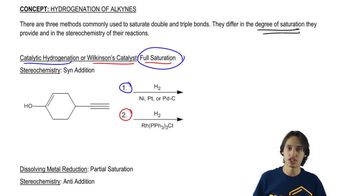
Using Catalytic hydrogenation or Wilkinson’s Catalyst to turn alkynes to alkanes.

Catalytic Hydrogenation

Catalytic hydrogenation is a process where hydrogen gas is added to unsaturated organic compounds in the presence of a catalyst. The catalyst lowers the activation energy required for the reaction, allowing for faster conversion. In this case, Pd/C serves as an effective catalyst for the hydrogenation of 2-butyne to butane.
Video consigliato:
05:21
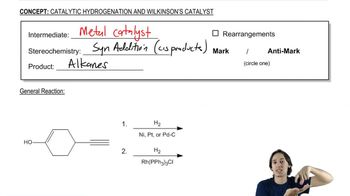
General properties of catalytic hydrogenation.

Reaction Mechanism

Understanding the reaction mechanism is crucial for predicting the outcome of chemical reactions. In the case of hydrogenation, the mechanism involves the adsorption of the alkyne onto the catalyst surface, followed by the addition of hydrogen atoms to the carbon atoms of the triple bond. This stepwise process leads to the formation of the saturated product, butane, from 2-butyne.
Video consigliato:
02:16
Heck Reaction Mechanism