Ch. 7 - The Reactions of Alkynes • An Introduction to Multistep Synthesis
Bruice - Organic Chemistry 8th Edition
Bruice8th EditionOrganic ChemistryISBN: 9780135213711Non è quello che usi tu?Cambia libro di testo
Capitolo 7, Problema 40f

Answer Problem 39, parts a–h, using 2-butyne as the starting material instead of propyne.
f. R2BH in THF followed by H2O2/HO− /H2O

Guida verificata passo dopo passo
1
Identify the starting material, 2-butyne, which is an alkyne with the structure CH≡C-CH2-CH3. The triple bond is located between the first and second carbons.
Understand the reagents: R2BH in THF is a hydroboration reagent that adds a boron atom and a hydrogen atom across the triple bond in a syn-addition manner. This step converts the alkyne into a trialkylborane intermediate.
Recognize the second step: H2O2/HO−/H2O is used to oxidize the trialkylborane intermediate into an enol. The enol then tautomerizes to form a carbonyl compound (a ketone or aldehyde).
Determine regioselectivity: Hydroboration-oxidation of terminal alkynes typically leads to the formation of aldehydes, while internal alkynes like 2-butyne yield ketones. The boron adds to the less substituted carbon of the triple bond, following anti-Markovnikov selectivity.
Conclude the product: The reaction of 2-butyne with R2BH followed by H2O2/HO−/H2O will result in the formation of a ketone, specifically 2-butanone, due to the internal alkyne structure and the regioselectivity of the reaction.

Risposta video verificata per un problema simile:

Questa soluzione video è stata consigliata dai nostri tutor come utile per risolvere questo problema.
Durata del video:
6m

Concetti chiave

Ecco i concetti essenziali che devi comprendere per rispondere correttamente alla domanda.

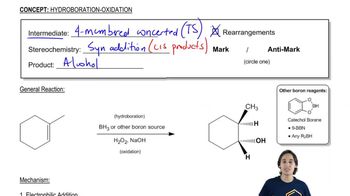
Hydroboration-Oxidation

Hydroboration-oxidation is a two-step reaction process used to convert alkenes and alkynes into alcohols. In the first step, a borane reagent (like R2BH) adds across the triple bond of the alkyne, forming a trialkylborane intermediate. The second step involves oxidation with hydrogen peroxide and a base, which replaces the boron with a hydroxyl group, yielding an alcohol. This method is notable for its anti-Markovnikov selectivity.
Video consigliato:
06:38
General properties of hydroboration-oxidation.

Alkyne Reactivity

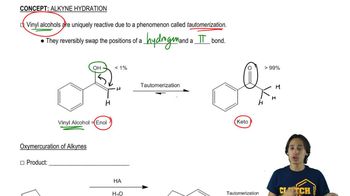
Alkynes, characterized by their carbon-carbon triple bonds, exhibit unique reactivity compared to alkenes and alkanes. They can undergo various reactions, including addition reactions, where reagents add across the triple bond. The reactivity of alkynes is influenced by their hybridization and the presence of electron-withdrawing groups, making them versatile intermediates in organic synthesis.
Video consigliato:
09:11
Alkyne Hydration

Regioselectivity

Regioselectivity refers to the preference of a chemical reaction to yield one structural isomer over others when multiple possibilities exist. In the context of hydroboration-oxidation, the reaction is regioselective, favoring the formation of the less substituted alcohol due to the mechanism of boron addition. Understanding regioselectivity is crucial for predicting the outcome of reactions involving unsaturated hydrocarbons.
Video consigliato:
05:09
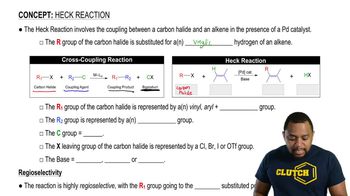
Heck Reaction