Ch. 7 - The Reactions of Alkynes • An Introduction to Multistep Synthesis
Bruice - Organic Chemistry 8th Edition
Bruice8th EditionOrganic ChemistryISBN: 9780135213711Non è quello che usi tu?Cambia libro di testo
Capitolo 7, Problema 7b

Name the following:
b.

Guida verificata passo dopo passo
1
Step 1: Identify the longest continuous carbon chain in the structure. This chain will serve as the parent chain and determine the base name of the compound. Count the number of carbons in the chain.
Step 2: Determine the functional groups present in the structure. In this case, there is a triple bond (alkyne) and a double bond (alkene). Note their positions along the parent chain.
Step 3: Assign numbers to the carbon atoms in the parent chain, starting from the end closest to the first functional group (either the triple bond or double bond) to ensure the lowest possible locants for the functional groups.
Step 4: Combine the names of the functional groups with their locants. Use the suffix '-yne' for the triple bond and '-ene' for the double bond. If both are present, the compound is named as an 'enyne,' with the double bond taking priority in numbering.
Step 5: Check for any substituents attached to the parent chain. Name and number them accordingly, and include them in the final name of the compound in alphabetical order.

Risposta video verificata per un problema simile:

Questa soluzione video è stata consigliata dai nostri tutor come utile per risolvere questo problema.
Durata del video:
5m

Concetti chiave

Ecco i concetti essenziali che devi comprendere per rispondere correttamente alla domanda.

Functional Groups

Functional groups are specific groups of atoms within molecules that are responsible for the characteristic chemical reactions of those molecules. Understanding functional groups is essential in organic chemistry as they determine the properties and reactivity of organic compounds. Common examples include hydroxyl (-OH), carboxyl (-COOH), and amino (-NH2) groups.
Video consigliato:
02:36
Identifying Functional Groups

Nomenclature

Nomenclature in organic chemistry refers to the systematic naming of organic compounds based on established rules. The International Union of Pure and Applied Chemistry (IUPAC) provides guidelines for naming compounds, which include identifying the longest carbon chain, naming functional groups, and assigning locants to indicate the position of substituents. Mastery of nomenclature is crucial for clear communication and understanding of organic structures.
Video consigliato:
Percorso guidato
4:02
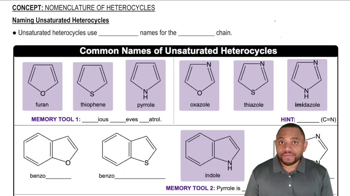
Nomenclature of Heterocycles Concept 2

Structural Representation

Structural representation involves depicting the arrangement of atoms within a molecule, which can be shown through various formats such as Lewis structures, condensed formulas, or skeletal structures. These representations help chemists visualize molecular geometry, bonding, and functional groups, which are vital for predicting reactivity and understanding the compound's behavior in chemical reactions.
Video consigliato:
05:09
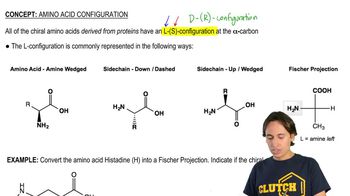
Representations of L-Configuration