Ch. 7 - The Reactions of Alkynes • An Introduction to Multistep Synthesis
Bruice - Organic Chemistry 8th Edition
Bruice8th EditionOrganic ChemistryISBN: 9780135213711Non è quello che usi tu?Cambia libro di testo
Capitolo 7, Problema 8g,h,i

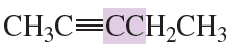
What orbitals are used to form the carbon–carbon s bond between the highlighted carbons?
g. Structural formula of butene, highlighting the carbon–carbon double bond and indicating orbital involvement.
h. Structural formula showing a carbon–carbon triple bond with highlighted carbons for orbital hybridization discussion.
i. Structural formula showing carbon atoms with highlighted orbitals forming a carbon–carbon s bond.

Guida verificata passo dopo passo
1
Step 1: Analyze the bonding in each structure. In organic molecules, sigma (σ) bonds are formed by the overlap of orbitals. The type of orbitals involved depends on the hybridization of the atoms forming the bond.
Step 2: For structure (i), the highlighted carbons are part of a double bond. Double bonds consist of one sigma bond and one pi bond. The sigma bond is formed by the overlap of sp² hybrid orbitals from each carbon atom.
Step 3: For structure (ii), the highlighted carbons are part of a triple bond. Triple bonds consist of one sigma bond and two pi bonds. The sigma bond is formed by the overlap of sp hybrid orbitals from each carbon atom.
Step 4: For structure (iii), the highlighted carbons are part of a double bond. Similar to structure (i), the sigma bond is formed by the overlap of sp² hybrid orbitals from each carbon atom.
Step 5: Summarize the orbital interactions: (i) sp²-sp² overlap for the sigma bond, (ii) sp-sp overlap for the sigma bond, and (iii) sp²-sp² overlap for the sigma bond.

Risposta video verificata per un problema simile:

Questa soluzione video è stata consigliata dai nostri tutor come utile per risolvere questo problema.
Durata del video:
5m

Concetti chiave

Ecco i concetti essenziali che devi comprendere per rispondere correttamente alla domanda.

Hybridization

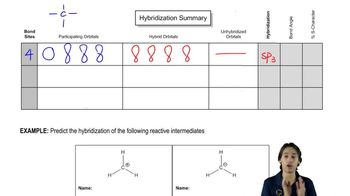
Hybridization is the concept of mixing atomic orbitals to form new hybrid orbitals that can accommodate bonding. In carbon, the most common hybridizations are sp3, sp2, and sp, which correspond to single, double, and triple bonds, respectively. Understanding hybridization is crucial for predicting the geometry and bond angles in molecules.
Video consigliato:
10:43
Using bond sites to predict hybridization

Sigma (σ) Bonds

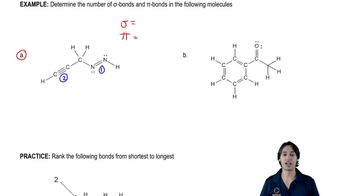
Sigma bonds are the first bonds formed between two atoms and are characterized by the head-on overlap of orbitals. In carbon–carbon bonds, σ bonds can be formed by the overlap of sp3, sp2, or sp hybrid orbitals. Recognizing the type of σ bond is essential for understanding molecular structure and reactivity.
Video consigliato:
01:05
Sigma bonds and pi bonds

Bonding Orbitals

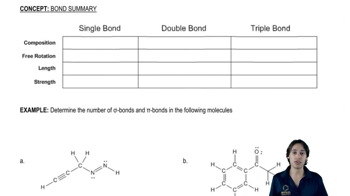
Bonding orbitals are regions in a molecule where the probability of finding electrons is high, leading to the formation of chemical bonds. In the context of carbon–carbon bonds, the specific orbitals involved (such as sp3, sp2, or sp) determine the bond's strength and characteristics. Identifying these orbitals is key to analyzing molecular interactions.
Video consigliato:
06:00
Single bonds, double bonds, and triple bonds.