
Ch. 8 - Delocalized Electrons: Their Effect on Stability, pKa, and the Products of a Reaction • Aromaticity and Electronic Effects: An Introduction to the Reactions of Benzene
Bruice - Organic Chemistry 8th Edition
Bruice8th EditionOrganic ChemistryISBN: 9780135213711Non è quello che usi tu?Cambia libro di testo
Capitolo 8, Problema 67a,b

a. How many linear dienes have molecular formula C6H10? (Disregard cis–trans isomers.)
b. How many of the linear dienes in part a are conjugated dienes?

Guida verificata passo dopo passo
1
Step 1: Understand the molecular formula C6H10. This formula represents a hydrocarbon with six carbon atoms and ten hydrogen atoms. Since it is a diene, it contains two double bonds. The molecule must be linear, meaning no branching is allowed.
Step 2: Determine the degree of unsaturation for C6H10. Use the formula for degree of unsaturation: \( \text{Degree of Unsaturation} = rac{2C + 2 - H}{2} \), where \( C \) is the number of carbon atoms and \( H \) is the number of hydrogen atoms. For C6H10, calculate \( \text{Degree of Unsaturation} = rac{2(6) + 2 - 10}{2} = 2 \). This indicates two double bonds or one ring and one double bond.
Step 3: Enumerate all possible linear structures with two double bonds. Since the molecule is linear, the double bonds can be placed in different positions along the carbon chain. Disregard cis-trans isomers, focusing only on connectivity. Consider all possible arrangements of the double bonds while ensuring the molecule remains linear and satisfies the molecular formula.
Step 4: Identify conjugated dienes among the structures. Conjugated dienes are characterized by alternating single and double bonds (e.g., \( -C=C-C=C- \)). Examine each structure from Step 3 to determine if the double bonds are conjugated or isolated (separated by more than one single bond).
Step 5: Count the total number of linear dienes and the subset of conjugated dienes. Ensure all structures satisfy the molecular formula and are linear. Summarize the findings for part a (total linear dienes) and part b (conjugated dienes).

Risposta video verificata per un problema simile:

Questa soluzione video è stata consigliata dai nostri tutor come utile per risolvere questo problema.
Durata del video:
8m

Concetti chiave

Ecco i concetti essenziali che devi comprendere per rispondere correttamente alla domanda.

Dienes

Dienes are organic compounds that contain two double bonds. They can be classified into different types based on the arrangement of these double bonds, such as isolated, conjugated, and cumulated dienes. Understanding the structure and classification of dienes is essential for determining their properties and reactivity.
Video consigliato:
04:43
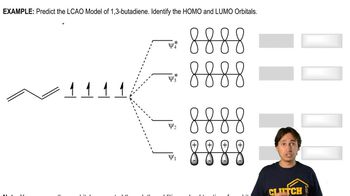
Drawing MO Diagram for Dienes

Molecular Formula and Structural Isomers

The molecular formula C6H10 indicates that the compound contains six carbon atoms and ten hydrogen atoms. Structural isomers are compounds that have the same molecular formula but different arrangements of atoms. Identifying all possible linear structures that fit this formula is crucial for answering the question about the number of linear dienes.
Video consigliato:
01:10
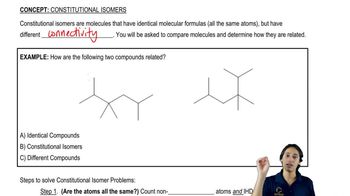
What is a constitutional isomer?

Conjugated Dienes

Conjugated dienes are a specific type of diene where the double bonds are separated by a single bond, allowing for delocalization of electrons. This delocalization can affect the stability and reactivity of the compound. Recognizing which of the linear dienes are conjugated is important for understanding their chemical behavior and properties.
Video consigliato:
03:27
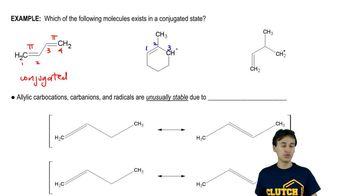
Conjugated states
Pratica correlata
Domanda del libro di testo

a. Draw resonance contributors for the following species. Do not include structures that are so unstable that their contributions to the resonance hybrid would be negligible. Indicate which are major contributors and which are minor contributors to the resonance hybrid.

b. Do any of the species have resonance contributors that all contribute equally to the resonance hybrid?

10.


852
views
Domanda del libro di testo

Are the following pairs of structures resonance contributors or different compounds?

d.

e.

1447
views
Domanda del libro di testo

a. Draw resonance contributors for the following species. Do not include structures that are so unstable that their contributions to the resonance hybrid would be negligible. Indicate which are major contributors and which are minor contributors to the resonance hybrid.

b. Do any of the species have resonance contributors that all contribute equally to the resonance hybrid?

15.

810
views
Domanda del libro di testo

a. Draw resonance contributors for the following species. Do not include structures that are so unstable that their contributions to the resonance hybrid would be negligible. Indicate which are major contributors and which are minor contributors to the resonance hybrid.

b. Do any of the species have resonance contributors that all contribute equally to the resonance hybrid?

5.

1231
views
Domanda del libro di testo

Draw resonance contributors for the following ions:

d.

1207
views
Domanda del libro di testo

Draw all the products of the following reaction:

745
views