Ch. 8 - Delocalized Electrons: Their Effect on Stability, pKa, and the Products of a Reaction • Aromaticity and Electronic Effects: An Introduction to the Reactions of Benzene
Bruice - Organic Chemistry 8th Edition
Bruice8th EditionOrganic ChemistryISBN: 9780135213711Non è quello che usi tu?Cambia libro di testo
Capitolo 8, Problema 73a

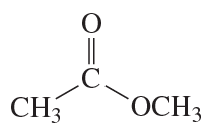
Which oxygen atom has the greater electron density?
Structural formula showing a carbon atom double-bonded to an oxygen atom, with two methyl groups attached.

Guida verificata passo dopo passo
1
Identify the functional group in the molecule. The structure contains an ester functional group, which consists of a carbonyl group (C=O) and an alkoxy group (-OCH3).
Examine the two oxygen atoms in the ester group. One oxygen is part of the carbonyl group (C=O), and the other is part of the alkoxy group (-OCH3).
Consider the electron density distribution. The oxygen in the carbonyl group is directly bonded to the carbon atom, which is sp2 hybridized and has a partial positive charge due to the electronegativity difference. This oxygen is involved in resonance with the carbonyl group, which delocalizes its electron density.
Analyze the alkoxy oxygen (-OCH3). This oxygen is bonded to a carbon atom and does not participate in resonance with the carbonyl group. It retains its lone pairs and is less influenced by electron withdrawal compared to the carbonyl oxygen.
Conclude that the alkoxy oxygen (-OCH3) has greater electron density because it is not involved in resonance and is less affected by the electron-withdrawing effects of the carbonyl group.

Risposta video verificata per un problema simile:

Questa soluzione video è stata consigliata dai nostri tutor come utile per risolvere questo problema.
Durata del video:
3m

Concetti chiave

Ecco i concetti essenziali che devi comprendere per rispondere correttamente alla domanda.

Electronegativity

Electronegativity is the tendency of an atom to attract electrons towards itself in a chemical bond. In organic chemistry, oxygen is more electronegative than carbon and hydrogen, which means it pulls electron density towards itself. This property is crucial for understanding the distribution of electron density in molecules, particularly in functional groups containing oxygen.
Video consigliato:
1:47
Electronegativity

Resonance Structures

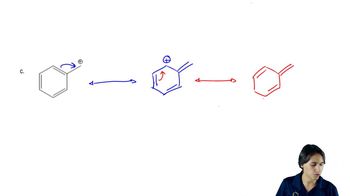
Resonance structures are different ways of drawing the same molecule that illustrate the delocalization of electrons. In the context of the given structure, resonance can affect the electron density around the oxygen atoms. The more resonance structures that can be drawn, the more stable the molecule is, and this can influence the electron density on specific atoms, including oxygen.
Video consigliato:
03:04
Drawing Resonance Structures

Inductive Effect

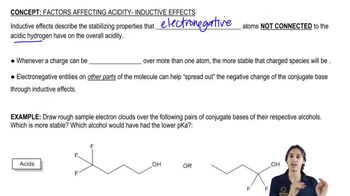
The inductive effect refers to the transmission of charge through a chain of atoms in a molecule due to the electronegativity differences. In the provided structure, the presence of electron-withdrawing groups (like the carbonyl group) can increase the electron density on adjacent atoms, including the oxygen atoms. Understanding this effect is essential for determining which oxygen atom has greater electron density.
Video consigliato:
01:47
Understanding the Inductive Effect.