Ch. 8 - Delocalized Electrons: Their Effect on Stability, pKa, and the Products of a Reaction • Aromaticity and Electronic Effects: An Introduction to the Reactions of Benzene
Bruice - Organic Chemistry 8th Edition
Bruice8th EditionOrganic ChemistryISBN: 9780135213711Non è quello che usi tu?Cambia libro di testo
Capitolo 8, Problema 71a,b

Which resonance contributor in each pair makes the greater contribution to the resonance hybrid?
a. Comparison of two resonance structures with charged atoms: CH3CH=CH2 or CH3CH=CH2.
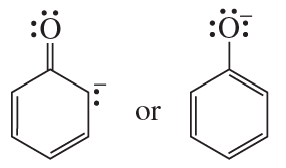
b. Two resonance structures of a molecule with oxygen, showing different electron arrangements and charges.

Guida verificata passo dopo passo
1
Step 1: Analyze the resonance contributors in pair A. Resonance contributors are evaluated based on stability factors such as charge distribution, electronegativity, and delocalization. In the first structure, the positive charge is on the carbon atom directly bonded to the double bond, which allows for some delocalization of the charge. In the second structure, the positive charge is on a tertiary carbon, which is more stable due to hyperconjugation and inductive effects from the surrounding alkyl groups.
Step 2: Determine which resonance contributor in pair A makes a greater contribution to the resonance hybrid. The second structure (with the positive charge on the tertiary carbon) is more stable and thus contributes more to the resonance hybrid.
Step 3: Analyze the resonance contributors in pair B. In the first structure, the negative charge is on the nitrogen atom, which is more electronegative and better able to stabilize the negative charge. In the second structure, the negative charge is on a carbon atom, which is less electronegative and less stable.
Step 4: Determine which resonance contributor in pair B makes a greater contribution to the resonance hybrid. The first structure (with the negative charge on the nitrogen atom) is more stable and thus contributes more to the resonance hybrid.
Step 5: Summarize the findings. For pair A, the resonance contributor with the positive charge on the tertiary carbon contributes more to the resonance hybrid. For pair B, the resonance contributor with the negative charge on the nitrogen atom contributes more to the resonance hybrid.

Risposta video verificata per un problema simile:

Questa soluzione video è stata consigliata dai nostri tutor come utile per risolvere questo problema.
Durata del video:
5m

Concetti chiave

Ecco i concetti essenziali che devi comprendere per rispondere correttamente alla domanda.

Resonance Structures

Resonance structures are different ways of drawing the same molecule that illustrate the delocalization of electrons. They help in understanding the actual electronic structure of a molecule, which is a hybrid of all possible resonance forms. The more stable the resonance structure, the greater its contribution to the resonance hybrid.
Video consigliato:
03:04
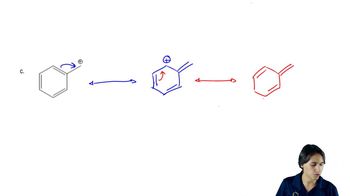
Drawing Resonance Structures

Stability of Resonance Contributors

The stability of resonance contributors is determined by factors such as the presence of formal charges, the electronegativity of atoms, and the overall charge distribution. Structures with minimal formal charges, full octets, and negative charges on more electronegative atoms are generally more stable and thus contribute more significantly to the resonance hybrid.
Video consigliato:
03:43
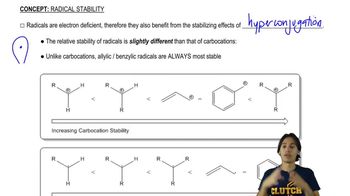
The radical stability trend.

Resonance Hybrid

The resonance hybrid is the actual structure of a molecule that is a weighted average of all its resonance contributors. It reflects the delocalization of electrons across the molecule, leading to increased stability. Understanding the resonance hybrid is crucial for predicting the reactivity and properties of organic compounds.
Video consigliato:
03:24
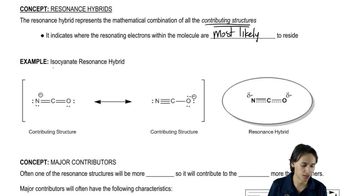
How to draw a resonance hybrid.