Ch. 8 - Delocalized Electrons: Their Effect on Stability, pKa, and the Products of a Reaction • Aromaticity and Electronic Effects: An Introduction to the Reactions of Benzene
Bruice - Organic Chemistry 8th Edition
Bruice8th EditionOrganic ChemistryISBN: 9780135213711Non è quello che usi tu?Cambia libro di testo
Capitolo 8, Problema 89a

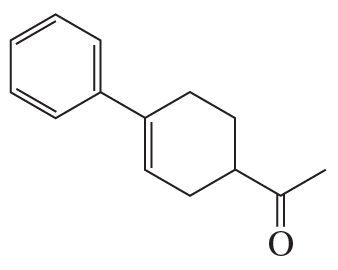
How could the following compounds be synthesized using a Diels–Alder reaction?
a. Chemical structure of a compound with a carbon ring and functional groups, illustrating a Diels-Alder reaction synthesis.

Guida verificata passo dopo passo
1
Identify the components of the Diels–Alder reaction: a diene (a molecule with two conjugated double bonds) and a dienophile (a molecule with a double or triple bond that reacts with the diene). Analyze the target compound to determine the structure of these components.
Determine the regiochemistry and stereochemistry of the product. The Diels–Alder reaction is stereospecific, meaning that the stereochemistry of the diene and dienophile will influence the stereochemistry of the product. Consider whether the product is endo or exo, as the endo product is typically favored due to secondary orbital interactions.
Work backward (retrosynthetic analysis) from the target compound to identify the diene and dienophile. Break the newly formed six-membered ring in the product to reveal the original double bonds of the diene and dienophile.
Verify that the identified diene is in the s-cis conformation, as this is required for the Diels–Alder reaction to occur. If the diene is not in the s-cis conformation, consider whether it can adopt this conformation during the reaction.
Propose the reaction conditions (e.g., heat or a specific solvent) that would facilitate the Diels–Alder reaction between the identified diene and dienophile to synthesize the target compound.

Risposta video verificata per un problema simile:

Questa soluzione video è stata consigliata dai nostri tutor come utile per risolvere questo problema.

Concetti chiave

Ecco i concetti essenziali che devi comprendere per rispondere correttamente alla domanda.

Diels–Alder Reaction

The Diels–Alder reaction is a [4+2] cycloaddition reaction between a conjugated diene and a dienophile, resulting in the formation of a six-membered ring. This reaction is a powerful tool in organic synthesis due to its ability to create complex cyclic structures in a single step, often with high stereoselectivity. Understanding the mechanism, including the role of orbital overlap and the formation of a transition state, is crucial for predicting the products formed.
Video consigliato:
04:02
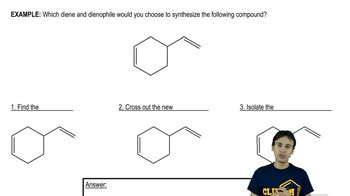
Diels-Alder Retrosynthesis

Conjugated Dienes

Conjugated dienes are compounds that contain two double bonds separated by a single bond, allowing for resonance stabilization and increased reactivity in cycloaddition reactions. The ability of these compounds to adopt a s-cis conformation is essential for participating in the Diels–Alder reaction, as this conformation allows optimal overlap of p-orbitals with the dienophile. Recognizing the structure and reactivity of conjugated dienes is vital for successful synthesis.
Video consigliato:
03:27
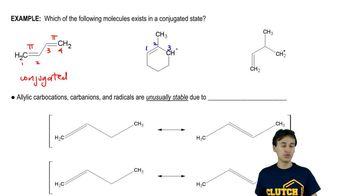
Conjugated states

Dienophiles

Dienophiles are electron-deficient alkenes or alkynes that react with conjugated dienes in the Diels–Alder reaction. Their reactivity is influenced by substituents that can either donate or withdraw electron density, affecting the overall reaction rate and product distribution. Understanding the nature of dienophiles, including their electronic properties and sterics, is essential for designing effective synthetic pathways in organic chemistry.
Video consigliato:
09:48
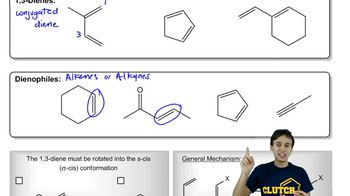
General Features