Domanda del libro di testo
Answer the following questions for the molecular orbitals (MOs) of 1,3,5,7-octatetraene:
e. Which MO is the HOMO and which is the LUMO in the excited state?
1205
views

 Bruice 8th EditionCh. 8 - Delocalized Electrons: Their Effect on Stability, pKa, and the Products of a Reaction • Aromaticity and Electronic Effects: An Introduction to the Reactions of BenzeneProblema 87
 Guida verificata passo dopo passo

 02:36
02:36
 01:22
01:22 01:52
01:52Answer the following questions for the molecular orbitals (MOs) of 1,3,5,7-octatetraene:
e. Which MO is the HOMO and which is the LUMO in the excited state?
A student obtained two products from the reaction of 1,3-cyclohexadiene with Br2 (disregarding stereoisomers). His lab partner was surprised when he obtained only one product from the reaction of 1,3-cyclohexadiene with HBr (disregarding stereoisomers). Account for these results.
Answer the following questions for the molecular orbitals (MOs) of 1,3,5,7-octatetraene:
g. How many nodes does the highest-energy MO of 1,3,5,7-octatetraene have between the nuclei?
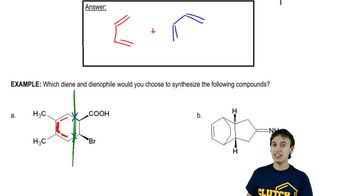
How could the following compounds be synthesized using a Diels–Alder reaction?
a.
How could the following compounds be synthesized using a Diels–Alder reaction?
b.
Answer the following questions for the molecular orbitals (MOs) of 1,3,5,7-octatetraene:
f. What is the relationship between HOMO and LUMO and symmetric and antisymmetric orbitals?