Indietro
 Mullins 1st EditionCh. 2 - General Chemistry Translated: Finding the Electrons
Problema 19
Fill in the blank. Oxygen ionizes to become ― 2 instead of ― 1 because O2- is more ___________ .
Problema 20b
(i) Using the periodic trend, choose the more electronegative atom in each pair. For one pair, you'll need to look at the actual Pauling values. (ii) For which one? (iii) Why?
(b) N vs. O
Problema 20d
(i) Using the periodic trend, choose the more electronegative atom in each pair. For one pair, you'll need to look at the actual Pauling values. (ii) For which one? (iii) Why?
(d) B vs. Si
Problema 23
Based on your answer to Assessment 2.22, would you expect a larger atom to be more or less electronegative than a smaller atom?
Problema 24a
Without looking at Figure 2.20, use your intuition to estimate whether a bond is ionic, polar covalent, or covalent.
(a) Na―Cl
Problema 25
Using only your intuition, rank the following covalent bonds in terms of their polarity (1 = most polar; 6 = least polar). [You can use the periodic trend of electronegativity, but don't use actual numbers.]
(a) C―C
(b) C―O
(c) C―H
(d) C―F
(e) C―Cl
(f) C―S
Problema 27b
Draw the Lewis structure for the following molecules. Be sure to calculate the formal charge of each atom as a way of confirming your structure is correct.
(b) HOBr
Problema 27c
Draw the Lewis structure for the following molecules. Be sure to calculate the formal charge of each atom as a way of confirming your structure is correct.
(c) CF4
Problema 28d
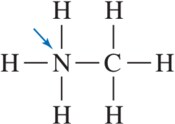
Calculate the formal charge of the indicated atom in the following molecules or ions.
(d)
Problema 28e
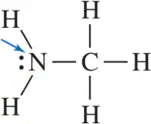
Calculate the formal charge of the indicated atom in the following molecules or ions.
(e)
Problema 28f
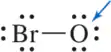
Calculate the formal charge of the indicated atom in the following molecules or ions.
(f)
Problema 29b
Draw the Lewis structure for the following ions. Be sure to calculate the formal charge of each atom to confirm that your structure is correct.
(b) H+
Problema 29c
Draw the Lewis structure for the following ions. Be sure to calculate the formal charge of each atom to confirm that your structure is correct.
(c) BH4-
Problema 29d
Draw the Lewis structure for the following ions. Be sure to calculate the formal charge of each atom to confirm that your structure is correct.
(d) AlCl4-
Problema 30a
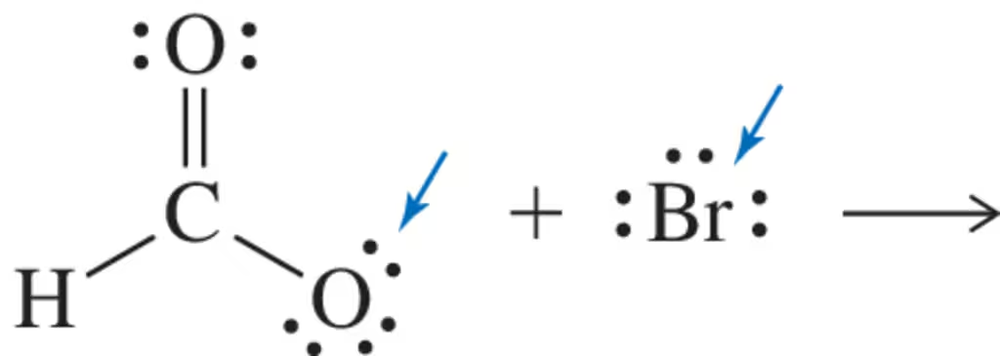
Calculate the formal charge of the indicated atoms in the ions shown.
Problema 33
Calculate the formal charge on the non-hydrogen atoms in the molecules shown. Use the arrow-pushing formalism to 'move' an electron pair such that it is shared between two (formerly) charged atoms. Your arrow should account for the formation of the molecule on the right from the molecule on the left.
Problema 35c
You drew the Lewis structures of the following compounds and ion in Assessment 2.32. Predict their shapes around the central atom based on the Lewis structure.
(c) HCO2H
Problema 35d
You drew the Lewis structures of the following compounds and ion in Assessment 2.32. Predict their shapes around the central atom based on the Lewis structure.
(d) CO32-
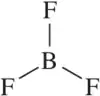
Problema 36a
For the molecules shown, indicate the direction of the dipole moment.
(a)
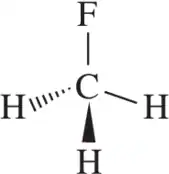
Problema 36b
For the molecules shown, indicate the direction of the dipole moment.
(b)
Problema 37
Hydrogen forms bonds without hybridizing. Why?
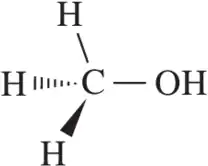
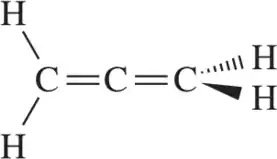
Problema 40a
Use hybrid orbitals to draw the following molecules.
(a)
Problema 40b
Use hybrid orbitals to draw the following molecules.
(b)
Problema 40c
Use hybrid orbitals to draw the following molecules.
(c)
Problema 40d
Use hybrid orbitals to draw the following molecules.
(d)
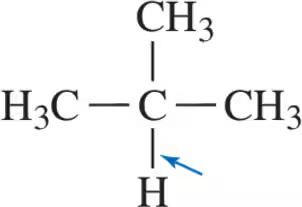
Problema 41
Rank the following molecules by the length of the indicated bond from shortest to longest.
(a)
(b)
(c)
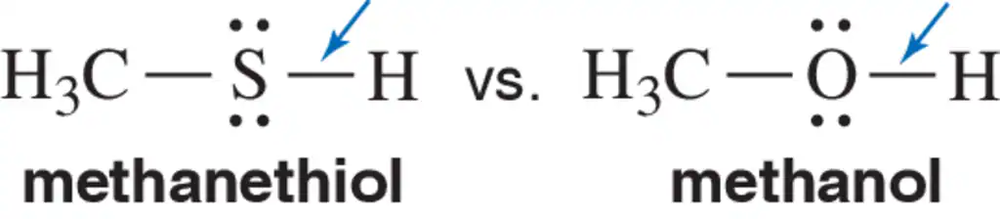
Problema 43
The sulfur and oxygen in methanethiol and methanol are both sp3 hybridized. Why is the S―H bond longer than the O―H bond?
Problema 44
A molecular orbital diagram is shown for the C―Cl bond in chloromethane. If two more electrons were added to chloromethane, where would the electrons go?
<IMAGE>
Problema 45
How might electrons be excited from π to π* based on the molecular orbital diagram shown? [This will be relevant in Chapter 21.]
<IMAGE>
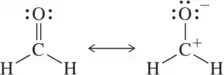
Problema 47a
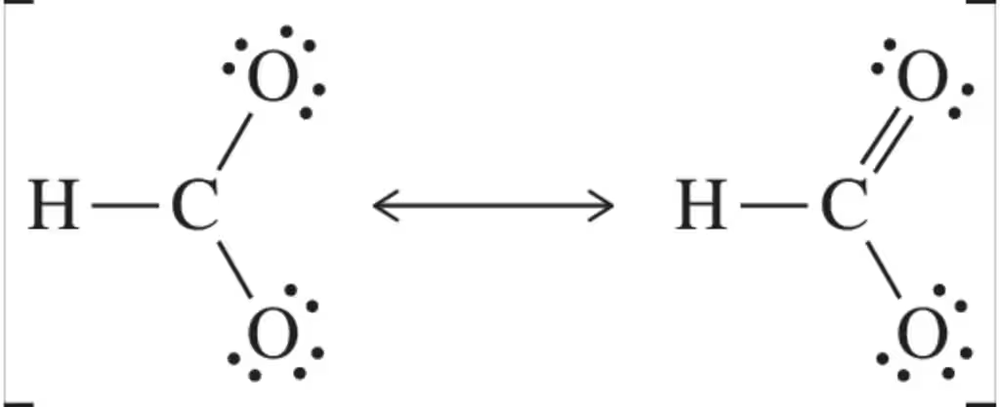
Each pair of structures represents two valid resonance structures. Use the arrow-pushing formalism to justify the formation of the one on the left from the one on the right.
(a)