Indietro
Problema 38f
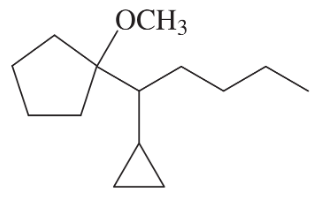
Develop syntheses for the following compounds. As starting materials, you may use cyclopentanol, alcohols containing no more than four carbon atoms, and any common reagents and solvents.
(f)
Problema 39a,b
Predict the major products of the following reactions, including stereochemistry where appropriate.
(a) (R)-butan-2-ol + TsCl in pyridine
(b) (S)-2-butyl tosylate + NaBr
Problema 39c,d
Predict the major products of the following reactions, including stereochemistry where appropriate.
(c) cyclooctanol + NaOCl/HOAC
(d) cyclopentylmethanol + CrO3·pyridine·HCl
Problema 39e,f,g
Predict the major products of the following reactions, including stereochemistry where appropriate.
(e) cyclopentylmethanol + Na2Cr2O7/H2SO4
(f) cyclopentanol + HCl/ZnCl2
(g) n-butanol + HBr
Problema 39h,i,j
Predict the major products of the following reactions, including stereochemistry where appropriate.
(h) cyclooctylmethanol + CH3CH2MgBr
(i) potassium tert-butoxide + methyl iodide
(j) sodium methoxide + tert-butyl iodide
Problema 39k,l,m
Predict the major products of the following reactions, including stereochemistry where appropriate.
(k) cyclopentanol + H2SO4/heat
(l) product from (k) + OsO4/H2O2, then HIO4
(m) sodium ethoxide + 1-bromobutane
Problema 39n,o,p
Predict the major products of the following reactions, including stereochemistry where appropriate.
(n) sodium ethoxide + 2-methyl-2-bromobutane
(o) octan-1-ol + DMSO + oxalyl chloride
(p) 4-cyclopentylhexan-1-ol + DMP reagent
Problema 40a,b,c
Show how you would convert 2-methylcyclopentanol to the following products. Any of these products may be used as the reactant in any subsequent part of this problem.
a. 1-methylcyclopentene
b. 2-methylcyclopentyl tosylate
c. 2-methylcyclopentanone
Problema 40d
Show how you would convert 2-methylcyclopentanol to the following products. Any of these products may be used as the reactant in any subsequent part of this problem.
d. 1-methylcyclopentanol
Problema 40g,h
Show how you would convert 2-methylcyclopentanol to the following products. Any of these products may be used as the reactant in any subsequent part of this problem.
(g) 2-methylcyclopentyl acetate
(h) 1-bromo-1-methylcyclopentane
Problema 41a,b
In each case, show how you would synthesize the chloride, bromide, and iodide from the corresponding alcohol.
(a) 1-halobutane (halo = chloro, bromo, iodo)
(b) halocyclopentane
Problema 42a,b
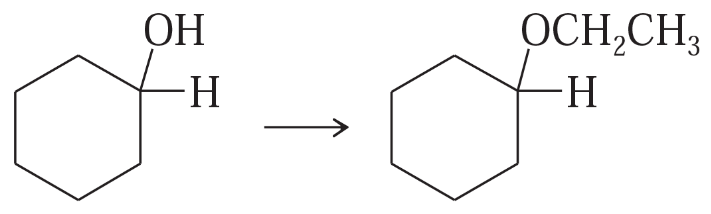
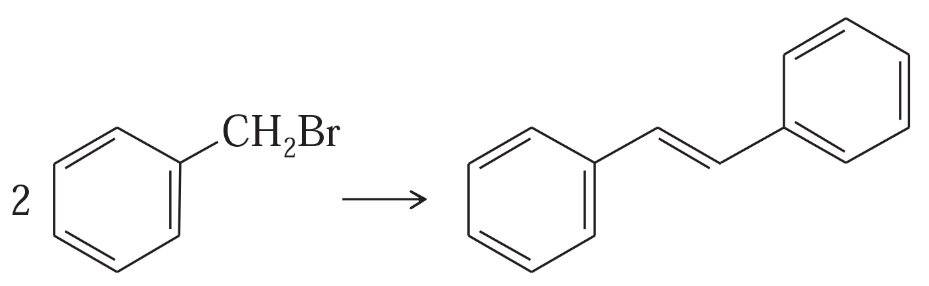
Show how you would accomplish the following synthetic conversions.
(a)
(b)
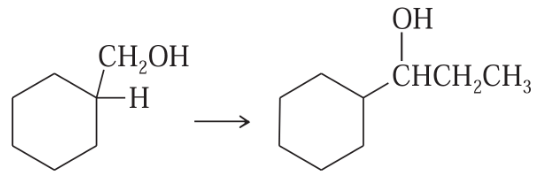
Problema 42c
Show how you would accomplish the following synthetic conversions.
(c)
Problema 42d
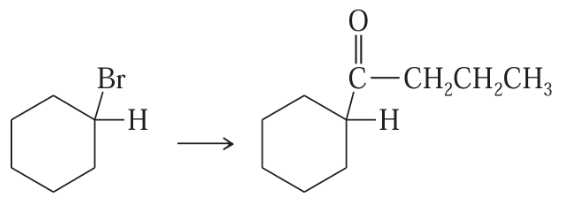
Show how you would accomplish the following synthetic conversions.
(d)
Problema 43a,b,c
Predict the major products of dehydration catalyzed by sulfuric acid.
(a) hexan-1-ol
(b) hexan-2-ol
(c) pentan-3-ol
Problema 44a,b,c
Predict the esterification products of the following acid/alcohol pairs.
(a) CH3CH2CH2COOH + CH3OH
(b) CH3OH + HNO3
(c) 2 CH3CH2OH + H3PO4
Problema 44d,e
Predict the esterification products of the following acid/alcohol pairs.
(d)
(e)
Problema 45
Both cis- and trans-2-methylcyclohexanol undergo dehydration in warm sulfuric acid to give 1-methylcyclohexene as the major alkene product. These alcohols can also be converted to alkenes by tosylation using TsCl and pyridine, followed by elimination using KOC(CH3)3 as a strong base. Under these basic conditions, the tosylate of cis-2-methylcyclohexanol eliminates to give mostly 1-methylcyclohexene, but the tosylate of trans-2-methylcyclohexanol eliminates to give only 3-methylcyclohexene. Explain how this stereochemical difference in reactants controls a regiochemical difference in the products of the basic elimination, but not in the acid-catalyzed elimination.
Problema 46a,b,c
Show how you would convert (S)-hexan-2-ol to
(a) (S)-2-chlorohexane.
(b) (R)-2-bromohexane.
(c) (R)-hexan-2-ol.
Problema 48d,e,f
Show how you would make each compound, beginning with an alcohol of your choice.
(d)
(e)
(f)
Problema 48g,h
Show how you would make each compound, beginning with an alcohol of your choice.
(g)
(h)
Problema 49a,b,c
Predict the major products (including stereochemistry) when cis-3-methylcyclohexanol reacts with the following reagents.
(a) PBr3
(b) SOCl2
(c) Lucas reagent
Problema 49d,e
Predict the major products (including stereochemistry) when cis-3-methylcyclohexanol reacts with the following reagents.
(d) concentrated HBr
(e) TsCl/pyridine, then NaBr
Problema 51
The compound shown below has three different types of OH groups, all with different acidities. Show the structure produced after this compound is treated with different amounts of NaH followed by a methylating reagent. Add a brief explanation.
(a) 1 equivalent of NaH, followed by 1 equivalent of CH3I and heat
(b) 2 equivalents of NaH, followed by 2 equivalents of CH3I and heat
(c) 3 equivalents of NaH, followed by 3 equivalents of CH3I and heat
Problema 52
Compound A is an optically active alcohol. Treatment with chromic acid converts A into a ketone, B. In a separate reaction, A is treated with PBr3, converting A into compound C. Compound C is purified, and then it is allowed to react with magnesium in ether to give a Grignard reagent, D. Compound B is added to the resulting solution of the Grignard reagent. After hydrolysis of the initial product (E), this solution is found to contain 3,4-dimethylhexan-3-ol. Propose structures for compounds A, B, C, D, and E.
Problema 53
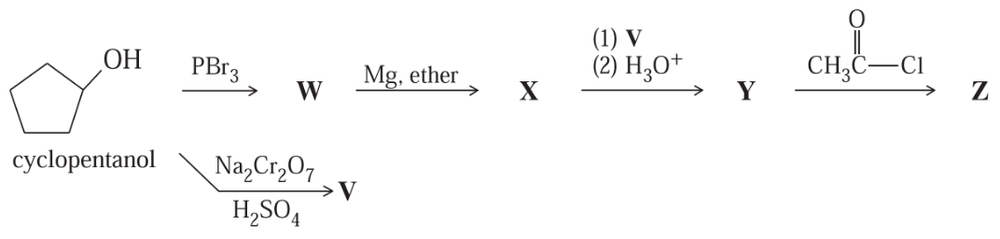
Give the structures of the intermediates and products V through Z.
Problema 54
Under acid catalysis, tetrahydrofurfuryl alcohol reacts to give surprisingly good yields of dihydropyran. Propose a mechanism to explain this useful synthesis.
Problema 55a
Propose mechanisms for the following reactions. In most cases, more products are formed than are shown here. You only need to explain the formation of the products shown, however.
(a)
Problema 55b
Propose mechanisms for the following reactions. In most cases, more products are formed than are shown here. You only need to explain the formation of the products shown, however.
(b)
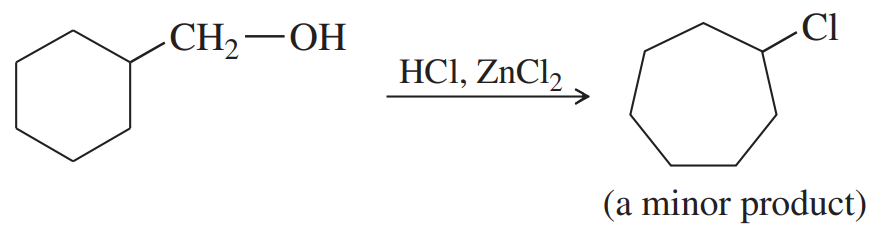
Problema 55c
Propose mechanisms for the following reactions. In most cases, more products are formed than are shown here. You only need to explain the formation of the products shown, however.
(c)