
Ch. 2 The Chemical Level of Organization
Martini - Fundamentals of Anatomy & Physiology 11th Edition
Martini, Nath, Bartholomew11th EditionFundamentals of Anatomy & PhysiologyISBN: 9780136874089당신이 사용하는 게 아니라요?교과서 변경
2장, 문제 26

Explain the differences among nonpolar covalent bonds, polar covalent bonds, and ionic bonds.

검증된 단계별 안내
1
Start by defining a covalent bond: it is a chemical bond where atoms share pairs of electrons to achieve stability.
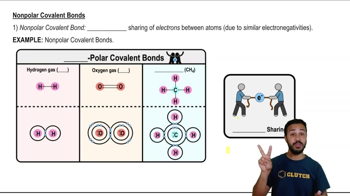
Explain nonpolar covalent bonds: these occur when two atoms share electrons equally because they have similar electronegativities, resulting in no partial charges on the atoms.
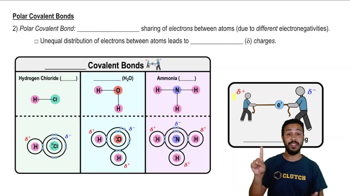
Describe polar covalent bonds: these happen when electrons are shared unequally between two atoms due to a difference in electronegativity, causing partial positive and negative charges (dipoles) on the atoms.
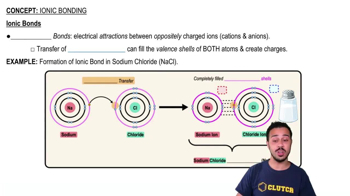
Define ionic bonds: these form when one atom donates one or more electrons to another atom, creating positively charged cations and negatively charged anions that attract each other due to opposite charges.
Summarize the key difference: nonpolar covalent bonds share electrons equally, polar covalent bonds share electrons unequally, and ionic bonds involve the transfer of electrons and electrostatic attraction between ions.

비슷한 문제에 대한 검증된 영상 답변:

이 영상 해법은 위 문제에 도움이 된다고 튜터들이 추천한 것입니다.
영상 길이:
3m
도움이 되었나요?

주요 개념

질문에 올바르게 답하기 위해 반드시 이해해야 하는 핵심 개념들은 다음과 같습니다.

Nonpolar Covalent Bonds

Nonpolar covalent bonds occur when two atoms share electrons equally due to similar electronegativities. This equal sharing results in a balanced distribution of electrical charge, typically found between identical atoms or atoms with very close electronegativity values.
추천 영상:
가이드 코스
05:58
Nonpolar Covalent Bonds

Polar Covalent Bonds

Polar covalent bonds form when electrons are shared unequally between two atoms with different electronegativities. This causes a partial positive charge on one atom and a partial negative charge on the other, creating a dipole moment within the molecule.
추천 영상:
가이드 코스
06:59
Polar Covalent Bonds

Ionic Bonds

Ionic bonds arise from the complete transfer of electrons from one atom to another, resulting in oppositely charged ions. These ions attract each other due to electrostatic forces, typically forming between metals and nonmetals with large differences in electronegativity.
추천 영상: