Ch. 26 The Urinary System
Martini - Fundamentals of Anatomy & Physiology 11th Edition
Martini, Nath, Bartholomew11th EditionFundamentals of Anatomy & PhysiologyISBN: 9780136874089당신이 사용하는 게 아니라요?교과서 변경
25장, 문제 26

In a normal kidney, which of the following conditions would cause an increase in the glomerular filtration rate (GFR)? 
(a) Constriction of the afferent arteriole
(b) A decrease in the pressure of the glomerulus
(c) An increase in the capsular hydrostatic pressure
(d) A decrease in the concentration of plasma proteins in the blood
(e) A decrease in the net glomerular filtration process

검증된 단계별 안내
1
Step 1: Understand that the glomerular filtration rate (GFR) depends on the net filtration pressure, which is influenced by hydrostatic and osmotic pressures in the glomerulus and Bowman's capsule. The main equation for net filtration pressure (NFP) is: \[ \text{NFP} = P_{GC} - P_{BC} - \pi_{GC} \] where \(P_{GC}\) is the glomerular capillary hydrostatic pressure, \(P_{BC}\) is the Bowman's capsule hydrostatic pressure, and \(\pi_{GC}\) is the glomerular capillary oncotic pressure (due to plasma proteins).
Step 2: Analyze how constriction of the afferent arteriole affects \(P_{GC}\). Constricting the afferent arteriole reduces blood flow into the glomerulus, which lowers \(P_{GC}\) and thus decreases GFR. So, option (a) would decrease GFR, not increase it.
Step 3: Consider the effect of a decrease in glomerular pressure (\(P_{GC}\)). Since \(P_{GC}\) drives filtration, a decrease in this pressure reduces the net filtration pressure and therefore decreases GFR. So, option (b) would decrease GFR.
Step 4: Evaluate the impact of an increase in capsular hydrostatic pressure (\(P_{BC}\)). An increase in \(P_{BC}\) opposes filtration by pushing fluid back into the glomerulus, reducing net filtration pressure and GFR. So, option (c) would decrease GFR.
Step 5: Examine the effect of a decrease in plasma protein concentration, which lowers the oncotic pressure (\(\pi_{GC}\)). Since oncotic pressure opposes filtration, a decrease in \(\pi_{GC}\) reduces the force pulling fluid back into capillaries, thereby increasing net filtration pressure and GFR. Therefore, option (d) would cause an increase in GFR.

비슷한 문제에 대한 검증된 영상 답변:

이 영상 해법은 위 문제에 도움이 된다고 튜터들이 추천한 것입니다.
도움이 되었나요?

주요 개념

질문에 올바르게 답하기 위해 반드시 이해해야 하는 핵심 개념들은 다음과 같습니다.

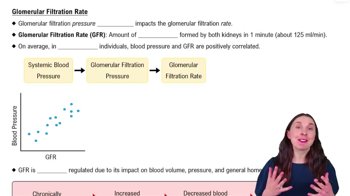
Glomerular Filtration Rate (GFR)

GFR is the rate at which blood is filtered through the glomeruli of the kidneys. It reflects kidney function and depends on the balance of pressures across the glomerular capillaries, including hydrostatic and oncotic pressures. Changes in these pressures or vessel diameter directly affect GFR.
추천 영상:
3:15
Glomerular Filtration Rate

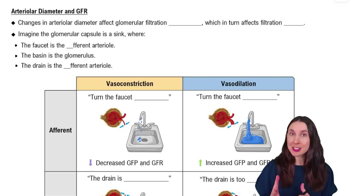
Afferent and Efferent Arteriole Dynamics

The afferent arteriole brings blood to the glomerulus, while the efferent arteriole carries it away. Constriction or dilation of these arterioles alters glomerular blood pressure and filtration rate. For example, constriction of the afferent arteriole reduces blood flow and lowers GFR.
추천 영상:
4:33
Arteriolar Diameter and GFR

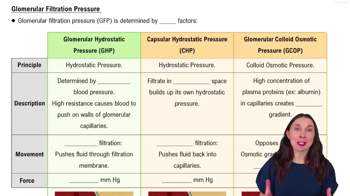
Starling Forces in Glomerular Filtration

Starling forces include hydrostatic pressure in the glomerulus and Bowman's capsule, and oncotic pressure from plasma proteins. An increase in glomerular hydrostatic pressure or a decrease in plasma protein concentration favors filtration, thereby increasing GFR, while opposing forces reduce it.
추천 영상:
3:49
Glomerular Filtration Pressure