
Ch. 26 The Urinary System
Martini - Fundamentals of Anatomy & Physiology 11th Edition
Martini, Nath, Bartholomew11th EditionFundamentals of Anatomy & PhysiologyISBN: 9780136874089당신이 사용하는 게 아니라요?교과서 변경
25장, 문제 25

Describe the urine voiding reflex.

검증된 단계별 안내
1
Step 1: Understand that the urine voiding reflex, also known as the micturition reflex, is a neural circuit that controls the process of emptying the bladder.
Step 2: Recognize that as the bladder fills with urine, stretch receptors in the bladder wall are activated when the bladder reaches a certain volume.
Step 3: These stretch receptors send afferent signals via the pelvic nerves to the sacral region of the spinal cord (segments S2-S4).
Step 4: The spinal cord processes this sensory information and sends efferent parasympathetic signals back to the detrusor muscle of the bladder, causing it to contract, while simultaneously inhibiting the somatic motor neurons that keep the external urethral sphincter contracted.
Step 5: This coordinated contraction of the detrusor muscle and relaxation of the urethral sphincters allows urine to be expelled from the bladder through the urethra, completing the voiding process.

비슷한 문제에 대한 검증된 영상 답변:

이 영상 해법은 위 문제에 도움이 된다고 튜터들이 추천한 것입니다.
도움이 되었나요?

주요 개념

질문에 올바르게 답하기 위해 반드시 이해해야 하는 핵심 개념들은 다음과 같습니다.

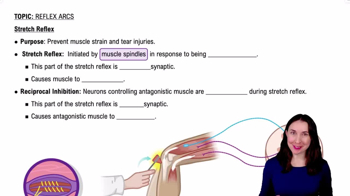
Micturition Reflex

The micturition reflex is a neural circuit that controls the process of urine voiding. It involves sensory signals from the bladder to the spinal cord and brain, triggering coordinated contraction of the detrusor muscle and relaxation of the urethral sphincters to allow urine expulsion.
추천 영상:
3:37
Stretch Reflex

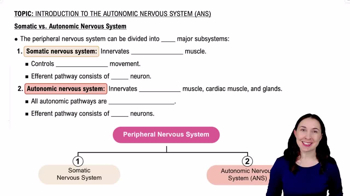
Role of the Autonomic Nervous System

The autonomic nervous system regulates bladder function through sympathetic and parasympathetic pathways. Parasympathetic activation causes detrusor muscle contraction for voiding, while sympathetic activity promotes bladder relaxation and sphincter contraction to store urine.
추천 영상:
1:50
Somatic vs. Autonomic Nervous System

Voluntary Control and Higher Brain Centers

Higher brain centers, including the pontine micturition center and cerebral cortex, provide voluntary control over urination. They coordinate the timing of voiding by inhibiting or facilitating the reflex, allowing conscious decision-making about when to urinate.
추천 영상:
2:05
Control of the ANS Example 2