
Ch. 26 The Urinary System
Martini - Fundamentals of Anatomy & Physiology 11th Edition
Martini, Nath, Bartholomew11th EditionFundamentals of Anatomy & PhysiologyISBN: 9780136874089당신이 사용하는 게 아니라요?교과서 변경
25장, 문제 24

Describe two functions of countercurrent multiplication in the kidney.

검증된 단계별 안내
1
Understand that countercurrent multiplication is a mechanism in the nephron, specifically in the loop of Henle, that helps concentrate urine and conserve water.
Identify the first function: it creates a concentration gradient in the medulla of the kidney by actively transporting sodium and chloride ions out of the thick ascending limb, which is impermeable to water, thus increasing the osmolarity of the surrounding interstitial fluid.
Identify the second function: it allows the descending limb, which is permeable to water but not to solutes, to lose water to the hyperosmotic medullary interstitium, concentrating the filtrate as it moves down the loop.
Explain how this gradient established by countercurrent multiplication enables the kidney to reabsorb water efficiently from the collecting ducts under the influence of antidiuretic hormone (ADH), thus producing concentrated urine.
Summarize that these functions together help maintain body fluid balance by conserving water and regulating the concentration of urine.

비슷한 문제에 대한 검증된 영상 답변:

이 영상 해법은 위 문제에 도움이 된다고 튜터들이 추천한 것입니다.
도움이 되었나요?

주요 개념

질문에 올바르게 답하기 위해 반드시 이해해야 하는 핵심 개념들은 다음과 같습니다.

Countercurrent Multiplication Mechanism

Countercurrent multiplication is a process in the kidney's loop of Henle where fluid flows in opposite directions in adjacent tubules, creating a concentration gradient. This mechanism allows the kidney to concentrate urine by actively transporting ions out of the ascending limb, which is impermeable to water, thereby increasing osmolarity in the medulla.
추천 영상:
3:02
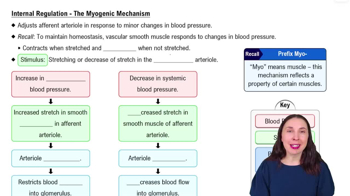
Internal Regulation - The Myogenic Mechanism

Role in Urine Concentration

Countercurrent multiplication helps the kidney produce urine that is more concentrated than blood plasma. By establishing a high osmolarity in the medullary interstitium, it enables water reabsorption from the collecting ducts, conserving water and maintaining body fluid balance.
추천 영상:
04:51
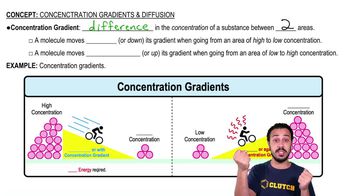
Concentration Gradients and Diffusion

Maintenance of Medullary Osmotic Gradient

This process maintains a steep osmotic gradient in the renal medulla, essential for water reabsorption. The active transport of sodium and chloride ions from the thick ascending limb into the interstitial space increases osmolarity, which drives water movement out of the descending limb and collecting ducts.
추천 영상:
04:51
Concentration Gradients and Diffusion