Ch. 26 The Urinary System
Martini - Fundamentals of Anatomy & Physiology 11th Edition
Martini, Nath, Bartholomew11th EditionFundamentals of Anatomy & PhysiologyISBN: 9780136874089당신이 사용하는 게 아니라요?교과서 변경
25장, 문제 22

What interacting controls stabilize the glomerular filtration rate (GFR)?

검증된 단계별 안내
1
Step 1: Understand that the glomerular filtration rate (GFR) is the rate at which blood is filtered through the glomeruli of the kidneys, and it is crucial to maintain it within a narrow range for proper kidney function.
Step 2: Identify the main interacting controls that stabilize GFR, which include intrinsic mechanisms (renal autoregulation) and extrinsic mechanisms (neural and hormonal controls).
Step 3: Explore the intrinsic controls, such as the myogenic mechanism, where the smooth muscle in the afferent arteriole responds to changes in blood pressure by constricting or dilating to maintain a stable GFR, and the tubuloglomerular feedback mechanism, where the macula densa cells sense sodium chloride levels and adjust afferent arteriole resistance accordingly.
Step 4: Examine the extrinsic controls, including sympathetic nervous system activation that can constrict afferent arterioles during stress or low blood pressure to reduce GFR, and hormonal influences like the renin-angiotensin-aldosterone system (RAAS), which adjusts blood volume and pressure to indirectly affect GFR.
Step 5: Summarize how these interacting controls work together dynamically to stabilize GFR by balancing blood flow into the glomerulus and the filtration pressure, ensuring efficient kidney filtration despite fluctuations in systemic blood pressure or fluid status.

비슷한 문제에 대한 검증된 영상 답변:

이 영상 해법은 위 문제에 도움이 된다고 튜터들이 추천한 것입니다.
도움이 되었나요?

주요 개념

질문에 올바르게 답하기 위해 반드시 이해해야 하는 핵심 개념들은 다음과 같습니다.

Autoregulation of GFR

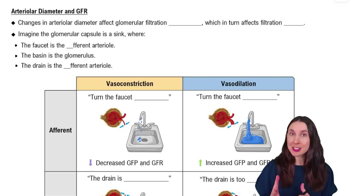
Autoregulation refers to the kidney's intrinsic ability to maintain a stable glomerular filtration rate despite fluctuations in systemic blood pressure. This is primarily achieved through mechanisms like the myogenic response and tubuloglomerular feedback, which adjust afferent arteriole resistance to keep filtration consistent.
추천 영상:
4:33
Arteriolar Diameter and GFR

Myogenic Mechanism

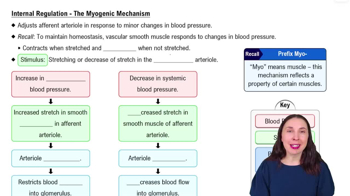
The myogenic mechanism involves the contraction or relaxation of smooth muscle in the afferent arteriole in response to changes in blood pressure. When blood pressure rises, the arteriole constricts to reduce blood flow and protect the glomerulus, thereby stabilizing GFR.
추천 영상:
3:02
Internal Regulation - The Myogenic Mechanism

Tubuloglomerular Feedback

Tubuloglomerular feedback is a process where the macula densa cells in the distal tubule sense sodium chloride concentration and signal the afferent arteriole to constrict or dilate. This feedback adjusts GFR by modulating blood flow based on the filtrate’s composition, ensuring balance in filtration and reabsorption.
추천 영상:
가이드 코스
02:43
Feedback Loops: Positive Feedback Example 1