For chlorine, identify the group number, give the number of electrons in each occupied shell, and write its valence-shell configuration.
Ch.2 Atoms and the Periodic Table
McMurry8th EditionFundamentals of General, Organic, and Biological ChemistryISBN: 9780134015187당신이 사용하는 게 아니라요?교과서 변경
2장, 문제 14
How many electrons are present in an atom in which the first and second shells and the 3s subshell are filled? Name the element.
검증된 단계별 안내1
Determine the maximum number of electrons that can be held in the first shell (n=1). The first shell contains only the 1s subshell, which can hold a maximum of 2 electrons.
Determine the maximum number of electrons that can be held in the second shell (n=2). The second shell contains the 2s and 2p subshells. The 2s subshell can hold 2 electrons, and the 2p subshell can hold 6 electrons, for a total of 8 electrons in the second shell.
Determine the number of electrons in the 3s subshell. The 3s subshell can hold a maximum of 2 electrons, as it is a single orbital.
Add the total number of electrons from the first shell, second shell, and 3s subshell: \( 2 + 8 + 2 \). This gives the total number of electrons in the atom.
Identify the element by matching the total number of electrons to its atomic number on the periodic table. The atomic number corresponds to the number of protons (and electrons in a neutral atom).

비슷한 문제에 대한 검증된 영상 답변:
이 영상 해법은 위 문제에 도움이 된다고 튜터들이 추천한 것입니다.
영상 길이:
5m도움이 되었나요?
주요 개념
질문에 올바르게 답하기 위해 반드시 이해해야 하는 핵심 개념들은 다음과 같습니다.
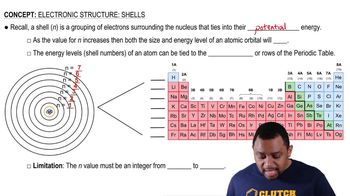
Electron Shells
Electron shells are the regions around an atom's nucleus where electrons are likely to be found. The first shell can hold up to 2 electrons, the second shell can hold up to 8 electrons, and subsequent shells can hold more. Understanding how many electrons each shell can accommodate is crucial for determining the total number of electrons in an atom.
추천 영상:
가이드 코스
Electronic Structure: Shells Concept 1
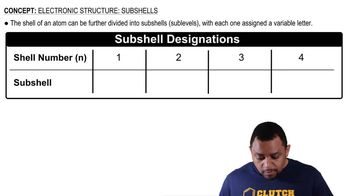
Subshells
Subshells are subdivisions of electron shells that contain orbitals where electrons reside. The 's' subshell can hold a maximum of 2 electrons. In the context of the question, the 3s subshell indicates that the third shell has its 's' orbital filled, contributing to the total electron count in the atom.
추천 영상:
가이드 코스
Electronic Structure: Subshells Concept 1
Element Identification
Identifying an element based on its electron configuration involves knowing the total number of electrons, which corresponds to the atomic number of the element. In this case, filling the first and second shells (2 + 8 = 10) and the 3s subshell (2) results in a total of 12 electrons, which corresponds to the element magnesium (Mg) on the periodic table.
추천 영상:
가이드 코스
Valence Electrons of Elements (Simplified) Example 1
관련 실천
교과서 질문
2046
views
교과서 질문
Locate aluminum in the periodic table and give its group number and period number.
1918
views
교과서 질문
Use the following blank periodic table to show where the elements matching the following descriptions appear.
a. Elements with the valence-shell electron configuration ns2 np5
b. An element whose third shell contains two p electrons
c. Elements with a completely filled valence shell
2803
views
교과서 질문
An element has completely filled n = 1 and n = 2 shells and has six electrons in the n = 3 shell. Identify the element and its major group (i.e., main group, transition, etc.). Is it a metal or a nonmetal? Identify the orbital in which the last electron is found.
2303
views