
Ch.4 Molecular Compounds
McMurry - Fundamentals of General, Organic, and Biological Chemistry 8th Edition
McMurry8th EditionFundamentals of General, Organic, and Biological ChemistryISBN: 9780134015187당신이 사용하는 게 아니라요?교과서 변경
4장, 문제 3

What are likely formulas for the following molecules?
a. CH2Cl?
b. BH?
c. NI?
d. SiCl?

검증된 단계별 안내
1
Step 1: Understand the problem. The question asks for the likely molecular formulas for the given molecules. This involves determining the number of atoms of each element in the molecule based on chemical bonding rules and the octet rule (or duet rule for hydrogen).
Step 2: Analyze part (a) CH₂Clɂ. Carbon typically forms four bonds to satisfy the octet rule. Hydrogen forms one bond, and chlorine forms one bond. To complete the structure, determine how many hydrogens and chlorines are needed to satisfy carbon's four bonds.
Step 3: Analyze part (b) BHɂ. Boron typically forms three bonds because it has three valence electrons. Hydrogen forms one bond. Determine how many hydrogens are needed to satisfy boron's bonding capacity.
Step 4: Analyze part (c) NIɂ. Nitrogen typically forms three bonds to satisfy the octet rule, and iodine typically forms one bond. Determine how many iodines are needed to satisfy nitrogen's bonding capacity.
Step 5: Analyze part (d) SiClɂ. Silicon, like carbon, typically forms four bonds to satisfy the octet rule. Chlorine forms one bond. Determine how many chlorines are needed to satisfy silicon's bonding capacity.

비슷한 문제에 대한 검증된 영상 답변:

이 영상 해법은 위 문제에 도움이 된다고 튜터들이 추천한 것입니다.
영상 길이:
8m
도움이 되었나요?

주요 개념

질문에 올바르게 답하기 위해 반드시 이해해야 하는 핵심 개념들은 다음과 같습니다.

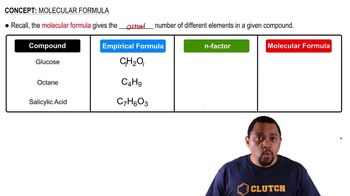
Molecular Formulas

A molecular formula represents the number and types of atoms in a molecule. It is expressed using chemical symbols and subscripts, indicating how many of each atom are present. For example, in CH₂Cl₂, 'C' stands for carbon, 'H' for hydrogen, and 'Cl' for chlorine, with subscripts showing the quantity of each atom.
추천 영상:
가이드 코스
02:08
Molecular Formula

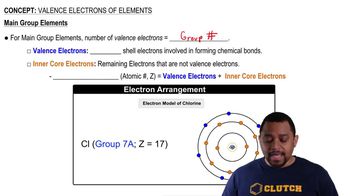
Valency and Bonding

Valency refers to the ability of an atom to bond with other atoms, determined by the number of electrons in its outer shell. Understanding valency is crucial for predicting how atoms combine to form molecules. For instance, carbon typically has a valency of four, allowing it to form four bonds, while chlorine has a valency of one.
추천 영상:
가이드 코스
01:55
Valence Electrons of Elements (Simplified) Concept 1

Common Chemical Notation

Chemical notation is a system of symbols used to represent chemical substances and their interactions. It includes not only molecular formulas but also structural formulas that depict how atoms are arranged. Familiarity with this notation helps in interpreting and writing chemical equations accurately, which is essential for identifying molecular formulas.
추천 영상:
가이드 코스
01:41
Scientific Notation