Ch.4 Molecular Compounds
McMurry - Fundamentals of General, Organic, and Biological Chemistry 8th Edition
McMurry8th EditionFundamentals of General, Organic, and Biological ChemistryISBN: 9780134015187당신이 사용하는 게 아니라요?교과서 변경
4장, 문제 35

Write electron-dot symbols to show the number of covalent bonds and the lone pairs of electrons in the molecules that are formed by reactions between the atoms in Problem 4.34.
a. Aluminum and bromine
b. Carbon and fluorine
c. Cesium and iodine
d. Zinc and fluorine
e. Lithium and chlorine

검증된 단계별 안내
1
Identify the atoms involved in the molecules from Problem 4.34 and determine their valence electrons using their group number in the periodic table. For example, Group 1 elements have 1 valence electron, Group 14 elements have 4 valence electrons, etc.
Determine how many covalent bonds each atom needs to form to achieve a full octet (or duet for hydrogen). This is typically done by subtracting the number of valence electrons from 8 (or 2 for hydrogen).
Draw the electron-dot symbols for each atom, showing their valence electrons as dots around the element symbol. Pair up electrons to form covalent bonds between atoms, ensuring that each atom achieves a full octet (or duet for hydrogen).
Indicate any lone pairs of electrons (non-bonding pairs) that remain on each atom after forming the covalent bonds. These are the electrons that are not shared between atoms.
Verify the structure by counting the total number of valence electrons in the molecule and ensuring it matches the sum of the valence electrons of all the atoms involved. Adjust the structure if necessary to satisfy the octet rule and maintain the correct number of electrons.

비슷한 문제에 대한 검증된 영상 답변:

이 영상 해법은 위 문제에 도움이 된다고 튜터들이 추천한 것입니다.
영상 길이:
4m
도움이 되었나요?

주요 개념

질문에 올바르게 답하기 위해 반드시 이해해야 하는 핵심 개념들은 다음과 같습니다.

Electron-Dot Symbols

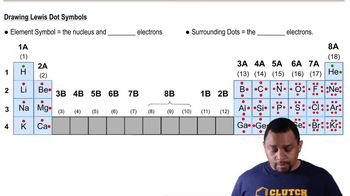
Electron-dot symbols, also known as Lewis dot structures, represent the valence electrons of an atom. Each dot corresponds to a valence electron, and they are used to illustrate how atoms bond with each other through covalent bonds. In these symbols, shared pairs of electrons are depicted as lines between atoms, while lone pairs are shown as pairs of dots.
추천 영상:
가이드 코스
01:27
Lewis Dot Symbols (Simplified) Concept 2

Covalent Bonds

Covalent bonds are chemical bonds formed when two atoms share one or more pairs of electrons. This sharing allows each atom to attain a full outer shell of electrons, achieving greater stability. The number of shared electron pairs determines the bond order, with single, double, and triple bonds representing one, two, and three shared pairs, respectively.
추천 영상:
가이드 코스
01:04
Covalent Bonds Example 1

Lone Pairs

Lone pairs are pairs of valence electrons that are not involved in bonding and remain localized on a single atom. They play a crucial role in determining the geometry and reactivity of molecules. In electron-dot symbols, lone pairs are represented as pairs of dots adjacent to the atom, influencing molecular shape and polarity.
추천 영상:
가이드 코스
2:56
Base Pairing Concept 1