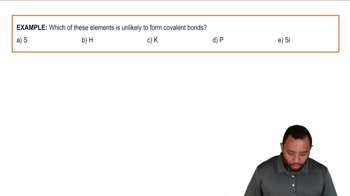
A compound of gallium with chlorine has a melting point of 77°C and a boiling point of 201°C. Is the compound ionic or covalent? What is a likely formula?
Ch.4 Molecular Compounds
McMurry8th EditionFundamentals of General, Organic, and Biological ChemistryISBN: 9780134015187당신이 사용하는 게 아니라요?교과서 변경
4장, 문제 38
Which of the following contains a coordinate covalent bond? (Hint: How many covalent bonds would you expect the central atom (underlined/bold) to form?)
a. PbCl2
b. Cu(NH3)42+
c. NH4+
검증된 단계별 안내1
Identify the definition of a coordinate covalent bond: A coordinate covalent bond occurs when one atom donates both electrons to form a shared pair in a covalent bond, typically seen in complex ions or molecules.
Analyze option a (PbCl₂): Lead (Pb) forms bonds with chlorine (Cl) through regular covalent or ionic bonding. There is no evidence of a coordinate covalent bond here.
Analyze option b (Cu(NH₃)₄²⁺): In this complex ion, the central copper ion (Cu²⁺) is surrounded by four ammonia (NH₃) molecules. Each NH₃ molecule donates a lone pair of electrons to the Cu²⁺ ion, forming coordinate covalent bonds.
Analyze option c (NH₄⁺): The ammonium ion (NH₄⁺) is formed when an NH₃ molecule donates a lone pair of electrons to a hydrogen ion (H⁺). This results in a coordinate covalent bond between NH₃ and H⁺.
Conclude: Based on the analysis, options b (Cu(NH₃)₄²⁺) and c (NH₄⁺) contain coordinate covalent bonds, while option a (PbCl₂) does not.

비슷한 문제에 대한 검증된 영상 답변:
이 영상 해법은 위 문제에 도움이 된다고 튜터들이 추천한 것입니다.
영상 길이:
7m도움이 되었나요?
주요 개념
질문에 올바르게 답하기 위해 반드시 이해해야 하는 핵심 개념들은 다음과 같습니다.
Covalent Bonding
Covalent bonding occurs when two atoms share one or more pairs of electrons, allowing each atom to attain a stable electron configuration. This type of bond is typically formed between nonmetals and can be classified into single, double, or triple bonds based on the number of shared electron pairs.
추천 영상:
가이드 코스
Covalent Bonds Example 1
Coordinate Covalent Bond
A coordinate covalent bond, also known as a dative bond, is a specific type of covalent bond where one atom donates both electrons to the bond. This often occurs in complex ions or molecules where a central atom, such as a metal, accepts a lone pair of electrons from a donor atom, leading to unique bonding scenarios.
추천 영상:
가이드 코스
Covalent Bonds Example 1
Central Atom and Valency
The central atom in a molecule is typically the atom that forms the most bonds and is often a metal or a nonmetal with a higher valency. Understanding the expected number of bonds that the central atom can form is crucial for predicting the type of bonds present, including whether coordinate covalent bonds are involved in the structure.
추천 영상:
가이드 코스
Valence Electrons of Elements (Simplified) Example 1
관련 실천
교과서 질문
2802
views
교과서 질문
Identify the bonds formed between the following pairs of atoms as either covalent or ionic.
d. Zinc and fluorine
2315
views
교과서 질문
What is a coordinate covalent bond, and how does it differ from a covalent bond?
3006
views
교과서 질문
Distinguish between the following:
c. A lone pair and a shared pair of electrons
1823
views
교과서 질문
Distinguish between the following:
b. A structural formula and a condensed structure
2615
views
교과서 질문
Write electron-dot symbols to show the number of covalent bonds and the lone pairs of electrons in the molecules that are formed by reactions between the atoms in Problem 4.34.
a. Aluminum and bromine
b. Carbon and fluorine
c. Cesium and iodine
d. Zinc and fluorine
e. Lithium and chlorine
2135
views