Ch.6 Chemical Reactions: Mole and Mass Relationships
McMurry - Fundamentals of General, Organic, and Biological Chemistry 8th Edition
McMurry8th EditionFundamentals of General, Organic, and Biological ChemistryISBN: 9780134015187당신이 사용하는 게 아니라요?교과서 변경
6장, 문제 53b

Nitrobenzene (C6H5NO2) is used in small quantities as a flavoring agent or in perfumes but can be toxic in large amounts. It is produced by reaction of benzene (C6H6) with nitric acid:
C6H6(l) + HNO3(aq) → C6H5NO2(l) + H2O(l)
b. Calculate the theoretical yield for this reaction.

검증된 단계별 안내
1
Step 1: Write the balanced chemical equation for the reaction. The given equation is already balanced: C6H6(l)+HNO3(aq)C6H5NO2(l)+H2O(l).
Step 2: Determine the molar masses of the reactants and products. Use the periodic table to calculate the molar masses: Benzene (C6H6) = 78.11 g/mol, Nitric acid (HNO3) = 63.01 g/mol, Nitrobenzene (C6H5NO2) = 123.11 g/mol.
Step 3: Identify the limiting reactant. To do this, calculate the number of moles of each reactant using the formula n=mM, where m is the mass of the substance and M is its molar mass. Compare the mole ratio of the reactants to the stoichiometric ratio in the balanced equation.
Step 4: Calculate the theoretical yield of nitrobenzene. Use the mole ratio from the balanced equation to determine the moles of nitrobenzene that can be produced from the limiting reactant. Then, convert moles of nitrobenzene to grams using its molar mass: m=n×M.
Step 5: Verify your calculations and ensure all units are consistent. Double-check the molar masses, mole ratios, and conversions to confirm the theoretical yield is accurate.

비슷한 문제에 대한 검증된 영상 답변:

이 영상 해법은 위 문제에 도움이 된다고 튜터들이 추천한 것입니다.
영상 길이:
2m
도움이 되었나요?

주요 개념

질문에 올바르게 답하기 위해 반드시 이해해야 하는 핵심 개념들은 다음과 같습니다.

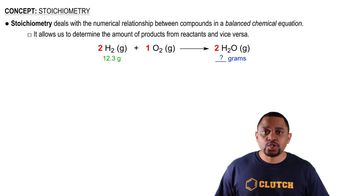
Stoichiometry

Stoichiometry is the branch of chemistry that deals with the quantitative relationships between the reactants and products in a chemical reaction. It involves using balanced chemical equations to determine the amounts of substances consumed and produced. In this case, understanding stoichiometry is essential for calculating the theoretical yield of nitrobenzene from benzene and nitric acid.
추천 영상:

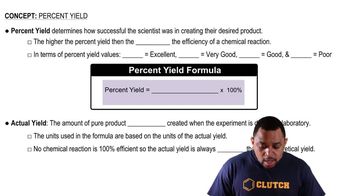
Theoretical Yield

Theoretical yield refers to the maximum amount of product that can be generated from a given amount of reactants, assuming complete conversion and no losses. It is calculated based on the stoichiometric coefficients from the balanced chemical equation. In this reaction, determining the theoretical yield of nitrobenzene requires knowing the initial amounts of benzene and nitric acid used.
추천 영상:

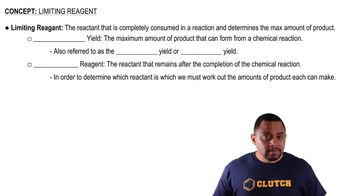
Limiting Reactant

The limiting reactant is the substance that is completely consumed first in a chemical reaction, thus determining the maximum amount of product that can be formed. Identifying the limiting reactant is crucial for calculating the theoretical yield, as it dictates how much of the product can be produced based on the initial quantities of reactants involved in the reaction.
추천 영상:
가이드 코스
01:30
Limiting Reagent
관련 실천
교과서 질문

In Problem 6.40, hydrazine reacted with oxygen according to the following (unbalanced) equation: N2H4(l) + O2(g) → NO2(g) + H2O(g)

a. If 75.0 kg of hydrazine are reacted with 75.0 kg of oxygen, which is the limiting reagent?

2002
views
교과서 질문

Although Cu is not sufficiently active to react with acids, it can be dissolved by concentrated nitric acid, which functions as an oxidizing agent according to the following equation:

Cu(s) + 4 HNO3(aq) → Cu(NO3)2(aq) + 2 NO2(g) + 2 H2O(l)

b. Is 35.0 g of HNO3 sufficient to dissolve 5.00 g of copper?

1825
views
교과서 질문

Titanium metal is obtained from the mineral rutile, TiO2. The process requires multiple steps, as shown in the following reactions:

TiO2(s) + 2 Cl2(g) + 2 C(s) → TiCl4(s) + 2 CO(g)

TiCl4(s) + 2 Mg(s) → Ti(s) + 2 MgCl2(s)

c. How many kilograms of rutile are needed to produce 95 kg of Ti?

1865
views
교과서 질문

Nitrobenzene (C6H5NO2) is used in small quantities as a flavoring agent or in perfumes but can be toxic in large amounts. It is produced by reaction of benzene (C6H6) with nitric acid:

C6H6(l) + HNO3(aq) → C6H5NO2(l) + H2O(l)

a. Identify the limiting reagent in the reaction of 27.5 g of nitric acid with 75 g of benzene.

2537
views
교과서 질문

When table sugar (sucrose, C12H22O11) is heated, it decomposes to form C and H2O.

b. How many grams of carbon are formed by the breakdown of 60.0 g of sucrose?

2581
views
교과서 질문

When table sugar (sucrose, C12H22O11) is heated, it decomposes to form C and H2O.

a. Write a balanced equation for the process.

3100
views