Ch.7 Chemical Reactions: Energy, Rate and Equilibrium
McMurry - Fundamentals of General, Organic, and Biological Chemistry 8th Edition
McMurry8th EditionFundamentals of General, Organic, and Biological ChemistryISBN: 9780134015187당신이 사용하는 게 아니라요?교과서 변경
7장, 문제 7c

Does entropy increase or decrease in the following processes?
c. 2 SO2(g) + O2(g) → 2 SO3(g)

검증된 단계별 안내
1
Step 1: Recall the concept of entropy. Entropy (S) is a measure of the disorder or randomness in a system. Processes that increase disorder typically result in an increase in entropy, while those that decrease disorder result in a decrease in entropy.
Step 2: Analyze the states of matter involved in the reaction. Gases generally have higher entropy compared to liquids or solids because gas particles are more disordered and have more freedom of movement.
Step 3: Count the number of gas molecules on both sides of the reaction. On the reactant side, there are 2 molecules of SO₂(g) and 1 molecule of O₂(g), for a total of 3 gas molecules. On the product side, there are 2 molecules of SO₃(g).
Step 4: Compare the number of gas molecules before and after the reaction. Since the number of gas molecules decreases from 3 to 2, the system becomes more ordered, indicating a decrease in entropy.
Step 5: Conclude that the entropy decreases in this reaction because the number of gas molecules is reduced, leading to a reduction in the overall disorder of the system.

비슷한 문제에 대한 검증된 영상 답변:

이 영상 해법은 위 문제에 도움이 된다고 튜터들이 추천한 것입니다.
영상 길이:
1m
도움이 되었나요?

주요 개념

질문에 올바르게 답하기 위해 반드시 이해해야 하는 핵심 개념들은 다음과 같습니다.

Entropy

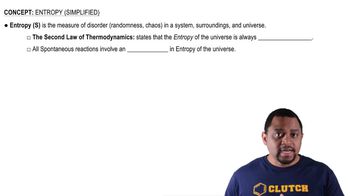
Entropy is a measure of the disorder or randomness in a system. In thermodynamics, it quantifies the number of microscopic configurations that correspond to a thermodynamic system's macroscopic state. Higher entropy indicates greater disorder, while lower entropy suggests more order. Understanding entropy is crucial for predicting the spontaneity of reactions and the direction of energy flow.
추천 영상:
가이드 코스
00:54
Entropy (Simplified) Concept 1

Gibbs Free Energy

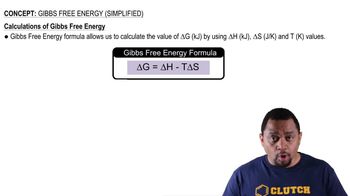
Gibbs Free Energy (G) is a thermodynamic potential that helps predict whether a process will occur spontaneously at constant temperature and pressure. It combines enthalpy and entropy into a single value, expressed as G = H - TS, where H is enthalpy, T is temperature, and S is entropy. A negative change in Gibbs Free Energy (ΔG < 0) indicates a spontaneous process, while a positive change suggests non-spontaneity.
추천 영상:
가이드 코스
01:04
Gibbs Free Energy (Simplified) Concept 3

Reaction Stoichiometry

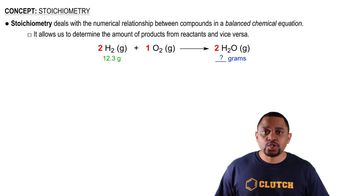
Reaction stoichiometry refers to the quantitative relationship between reactants and products in a chemical reaction. It is represented by the balanced chemical equation, which indicates the proportions of each substance involved. In the given reaction, the stoichiometry shows that two moles of SO2 and one mole of O2 produce two moles of SO3, allowing for the analysis of changes in the number of gas molecules and their impact on entropy.
추천 영상: