Ch.7 Chemical Reactions: Energy, Rate and Equilibrium
McMurry - Fundamentals of General, Organic, and Biological Chemistry 8th Edition
McMurry8th EditionFundamentals of General, Organic, and Biological ChemistryISBN: 9780134015187당신이 사용하는 게 아니라요?교과서 변경
7장, 문제 4c

The following equation shows the conversion of aluminum oxide (from the ore bauxite) to aluminum:
2 Al2O3(s) → 4 Al(s) + 3 O2(g) ∆H = +801 kcal/mol (+3350 kJ/mol)
c. How many kilocalories are required to produce 10.0 g of aluminum? How many kilojoules?

검증된 단계별 안내
1
Step 1: Calculate the molar mass of aluminum (Al) using the periodic table. The atomic mass of aluminum is approximately 26.98 g/mol.
Step 2: Convert the given mass of aluminum (10.0 g) to moles using the formula: moles = mass / molar mass. Substitute the values: moles = 10.0 g / 26.98 g/mol.
Step 3: Use the stoichiometry of the reaction to determine the relationship between moles of aluminum and the enthalpy change (∆H). From the balanced equation, 4 moles of Al correspond to +801 kcal. Set up a proportion to find the energy required for the calculated moles of aluminum.
Step 4: Convert the energy from kilocalories to kilojoules using the conversion factor: 1 kcal = 4.184 kJ. Multiply the energy in kilocalories by 4.184 to find the energy in kilojoules.
Step 5: Report the energy required in both kilocalories and kilojoules, ensuring the units are clearly labeled.

비슷한 문제에 대한 검증된 영상 답변:

이 영상 해법은 위 문제에 도움이 된다고 튜터들이 추천한 것입니다.
영상 길이:
1m

주요 개념

질문에 올바르게 답하기 위해 반드시 이해해야 하는 핵심 개념들은 다음과 같습니다.

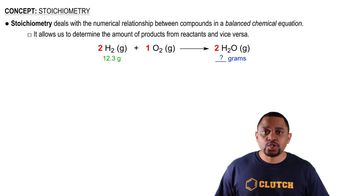
Stoichiometry

Stoichiometry is the branch of chemistry that deals with the quantitative relationships between the reactants and products in a chemical reaction. It allows us to calculate the amounts of substances consumed and produced in a reaction based on balanced chemical equations. In this case, stoichiometry will help determine how much aluminum can be produced from a given mass of aluminum oxide.
추천 영상:

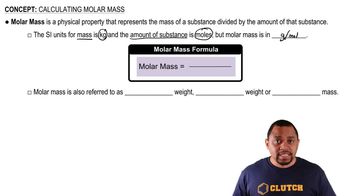
Molar Mass

Molar mass is the mass of one mole of a substance, typically expressed in grams per mole (g/mol). It is essential for converting between the mass of a substance and the number of moles, which is necessary for stoichiometric calculations. For aluminum, the molar mass is approximately 27 g/mol, which will be used to find out how many moles correspond to 10.0 g of aluminum.
추천 영상:
가이드 코스
01:10
Calculating Molar Mass

Enthalpy Change (∆H)

Enthalpy change (∆H) represents the heat absorbed or released during a chemical reaction at constant pressure. In this equation, the positive value indicates that the reaction is endothermic, meaning it requires energy input. Understanding ∆H is crucial for calculating the total energy required to produce a specific amount of aluminum from aluminum oxide, as it directly relates to the amount of heat needed per mole of aluminum produced.
추천 영상:
가이드 코스
01:17
Physical & Chemical Changes