Ch.7 Chemical Reactions: Energy, Rate and Equilibrium
McMurry - Fundamentals of General, Organic, and Biological Chemistry 8th Edition
McMurry8th EditionFundamentals of General, Organic, and Biological ChemistryISBN: 9780134015187당신이 사용하는 게 아니라요?교과서 변경
7장, 문제 38a

For the reaction 2 Hg(l) + O2(g) → 2 HgO(s), ∆H = –43 kcal/mol (–180 kJ/mol).
a. Does entropy increase or decrease in this process? Explain.

검증된 단계별 안내
1
Analyze the reaction: The reaction involves 2 moles of liquid mercury (Hg) and oxygen gas (O₂) combining to form 2 moles of solid mercury(II) oxide (HgO). Note the states of matter: liquid (l), gas (g), and solid (s).
Understand entropy (∆S): Entropy is a measure of disorder or randomness in a system. Gases have the highest entropy, followed by liquids, and then solids, which have the lowest entropy.
Compare the states of matter: In the reactants, there is one gaseous molecule (O₂) and two liquid molecules (Hg). In the product, there are two solid molecules (HgO). The transition from gas and liquid to solid indicates a decrease in entropy because solids are more ordered than gases and liquids.
Relate entropy change to the reaction: Since the reaction results in a more ordered state (solid HgO) and reduces the number of gas molecules, the entropy of the system decreases.
Conclude: The entropy decreases in this process because the system transitions from a mixture of liquid and gas to a solid, which is a more ordered state.

비슷한 문제에 대한 검증된 영상 답변:

이 영상 해법은 위 문제에 도움이 된다고 튜터들이 추천한 것입니다.
영상 길이:
3m
도움이 되었나요?

주요 개념

질문에 올바르게 답하기 위해 반드시 이해해야 하는 핵심 개념들은 다음과 같습니다.

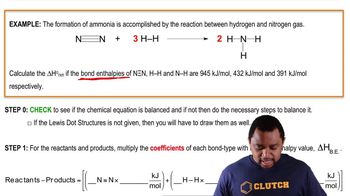
Enthalpy (∆H)

Enthalpy is a thermodynamic property that reflects the total heat content of a system. In the given reaction, the negative value of ∆H indicates that the reaction is exothermic, meaning it releases heat. This release of heat can influence the entropy of the system, as it affects the distribution of energy among the particles involved.
추천 영상:
가이드 코스
02:32
Bond Energy Example 1

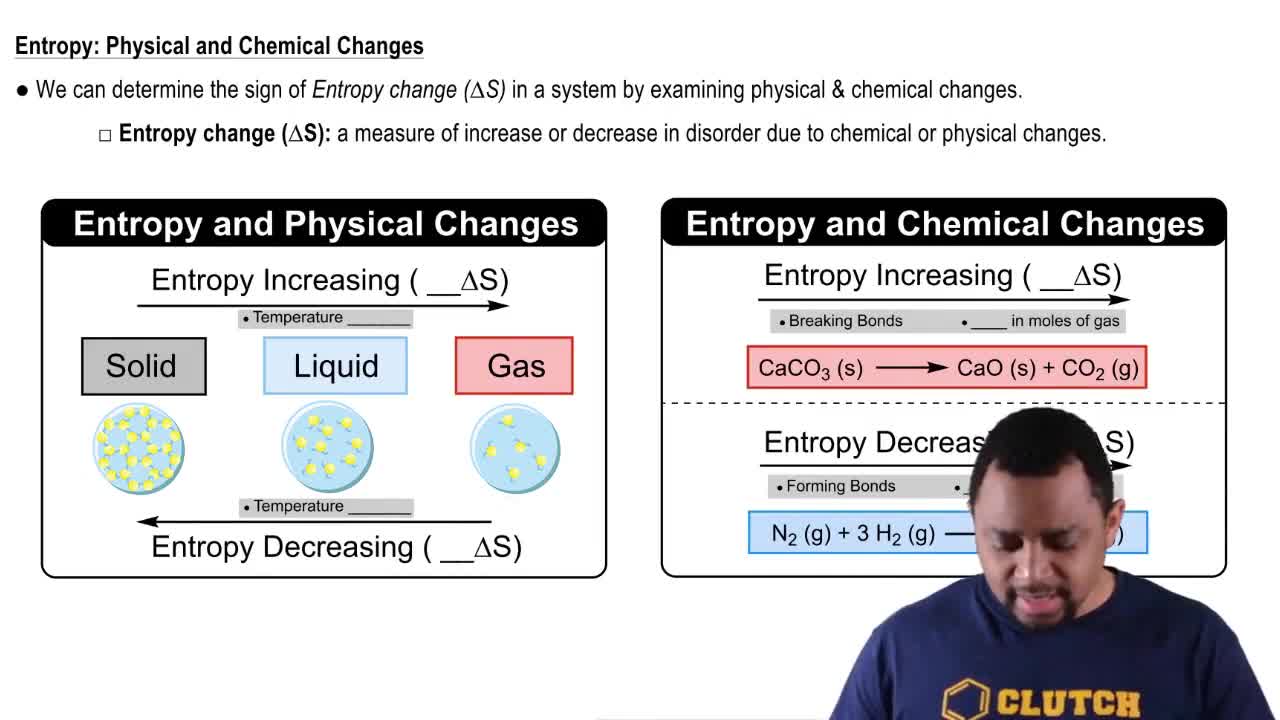
Entropy (S)

Entropy is a measure of the disorder or randomness in a system. In chemical reactions, an increase in the number of gas molecules typically leads to an increase in entropy, while the formation of solid products from liquids or gases usually results in a decrease in entropy. Understanding how the states of matter change in a reaction is crucial for predicting entropy changes.
추천 영상:
가이드 코스
03:22
Entropy (Simplified) Concept 2

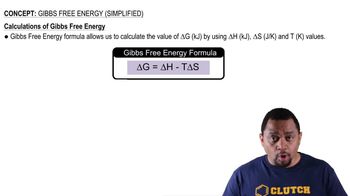
Gibbs Free Energy (∆G)

Gibbs Free Energy combines enthalpy and entropy to determine the spontaneity of a reaction at constant temperature and pressure. The relationship ∆G = ∆H - T∆S helps assess whether a reaction will occur spontaneously. In this case, knowing the signs of ∆H and ∆S can help predict the overall change in free energy and the direction of the reaction.
추천 영상:
가이드 코스
01:04
Gibbs Free Energy (Simplified) Concept 3