
Ch.7 Chemical Reactions: Energy, Rate and Equilibrium
McMurry - Fundamentals of General, Organic, and Biological Chemistry 8th Edition
McMurry8th EditionFundamentals of General, Organic, and Biological ChemistryISBN: 9780134015187당신이 사용하는 게 아니라요?교과서 변경
7장, 문제 60a

Hydrogen chloride can be made from the reaction of chlorine and hydrogen:
Cl2(g) + H2(g) → 2 HCl(g)
For this reaction, K = 26 × 1033 and ∆H = -44 kcal/mol(-184 kJ/mol) at 25 °C.
a. Is the reaction endothermic or exothermic?

검증된 단계별 안내
1
Identify whether the reaction is endothermic or exothermic by analyzing the given enthalpy change (∆H). A negative ∆H value indicates that the reaction releases heat, making it exothermic, while a positive ∆H value would indicate an endothermic reaction.
In this problem, the enthalpy change (∆H) is given as -44 kcal/mol (-184 kJ/mol). Since the value is negative, this means the reaction releases heat.
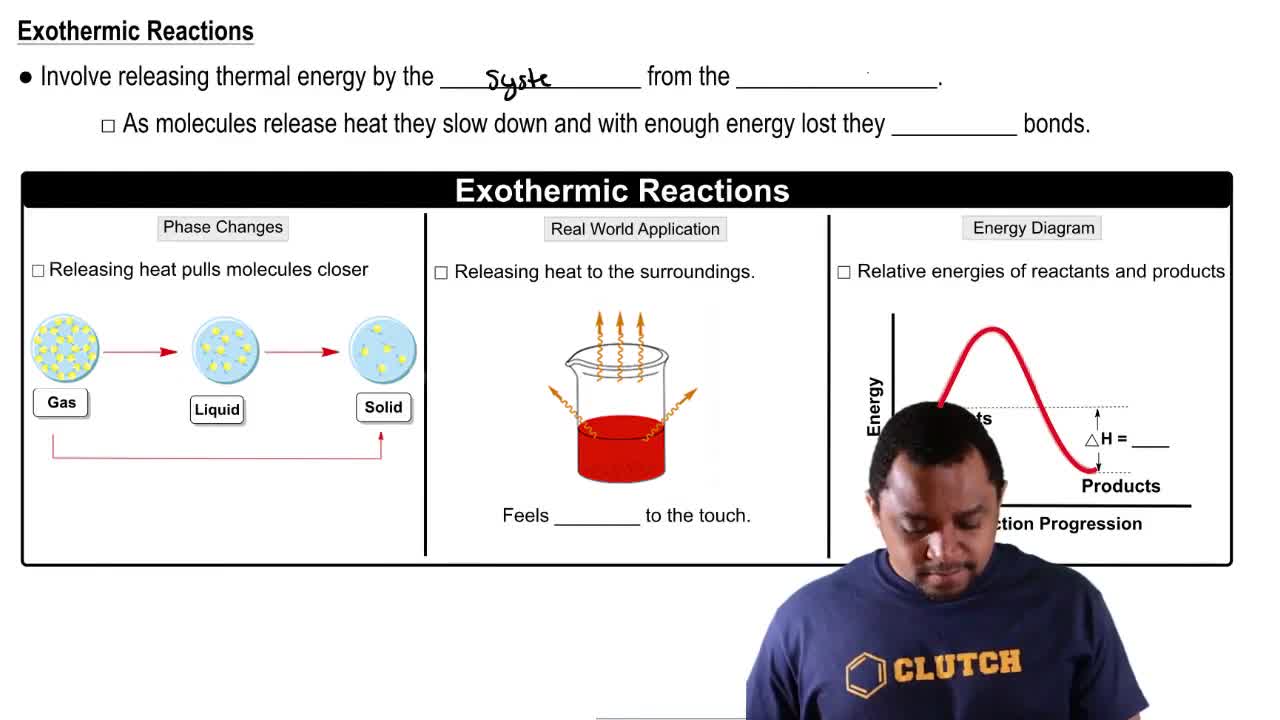
Recall the definition of an exothermic reaction: it is a reaction that releases energy in the form of heat to the surroundings, resulting in a decrease in the system's enthalpy.
Conclude that the reaction is exothermic because the negative ∆H value confirms that heat is being released during the reaction.
Additionally, note that the large equilibrium constant (K = 26 x 10^33) suggests the reaction strongly favors the formation of products, which aligns with the exothermic nature of the reaction.

비슷한 문제에 대한 검증된 영상 답변:

이 영상 해법은 위 문제에 도움이 된다고 튜터들이 추천한 것입니다.
영상 길이:
1m

주요 개념

질문에 올바르게 답하기 위해 반드시 이해해야 하는 핵심 개념들은 다음과 같습니다.

Exothermic and Endothermic Reactions

Exothermic reactions release energy, usually in the form of heat, to the surroundings, resulting in a temperature increase. In contrast, endothermic reactions absorb energy from the surroundings, leading to a temperature decrease. The sign of the enthalpy change (∆H) indicates the nature of the reaction: negative values signify exothermic reactions, while positive values indicate endothermic reactions.
추천 영상:
가이드 코스
02:38
Endothermic & Exothermic Reactions

Enthalpy Change (∆H)

Enthalpy change (∆H) is a measure of the total heat content of a system during a chemical reaction. It reflects the energy absorbed or released when reactants convert to products. A negative ∆H value, such as -44 kcal/mol in this reaction, indicates that the reaction releases heat, confirming it as exothermic.
추천 영상:
가이드 코스
01:17
Physical & Chemical Changes

Equilibrium Constant (K)

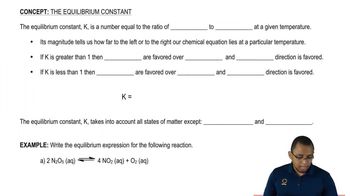
The equilibrium constant (K) quantifies the ratio of the concentrations of products to reactants at equilibrium for a given reaction at a specific temperature. A very large K value, like 26 x 10^33, suggests that the products are favored at equilibrium, indicating that the reaction proceeds almost to completion. This can also imply a strong driving force for the reaction, often associated with exothermic processes.
추천 영상:
가이드 코스
02:50
The Equilibrium Constant Concept 1