
Ch.7 Chemical Reactions: Energy, Rate and Equilibrium
McMurry - Fundamentals of General, Organic, and Biological Chemistry 8th Edition
McMurry8th EditionFundamentals of General, Organic, and Biological ChemistryISBN: 9780134015187당신이 사용하는 게 아니라요?교과서 변경
7장, 문제 59a

Oxygen can be converted into ozone by the action of lightning or electric sparks:
3 O2(g) ⇌ 2 O3(g)
For this reaction, ∆H = +69kcal/mol (+285 kj/mol) and K = 2.68 × 10⁻²⁹ at 25 °C.
a. Is the reaction exothermic or endothermic?

검증된 단계별 안내
1
Identify whether the reaction absorbs or releases heat by analyzing the given enthalpy change (∆H). A positive ∆H value indicates that the reaction absorbs heat, making it endothermic, while a negative ∆H value would indicate an exothermic reaction.
In this problem, the enthalpy change (∆H) is given as +69 kcal/mol (+285 kJ/mol). Since the value is positive, this means the reaction absorbs heat from the surroundings.
Conclude that the reaction is endothermic because it requires energy input to proceed, as indicated by the positive ∆H value.
Recall that endothermic reactions are typically associated with an increase in the energy of the system, as energy is absorbed to form the products.
Note that the equilibrium constant (K) being very small (2.68 x 10^-29) at 25 °C suggests that the reaction strongly favors the reactants (O2) under standard conditions, but this does not affect the classification of the reaction as endothermic.

비슷한 문제에 대한 검증된 영상 답변:

이 영상 해법은 위 문제에 도움이 된다고 튜터들이 추천한 것입니다.
영상 길이:
1m
도움이 되었나요?

주요 개념

질문에 올바르게 답하기 위해 반드시 이해해야 하는 핵심 개념들은 다음과 같습니다.

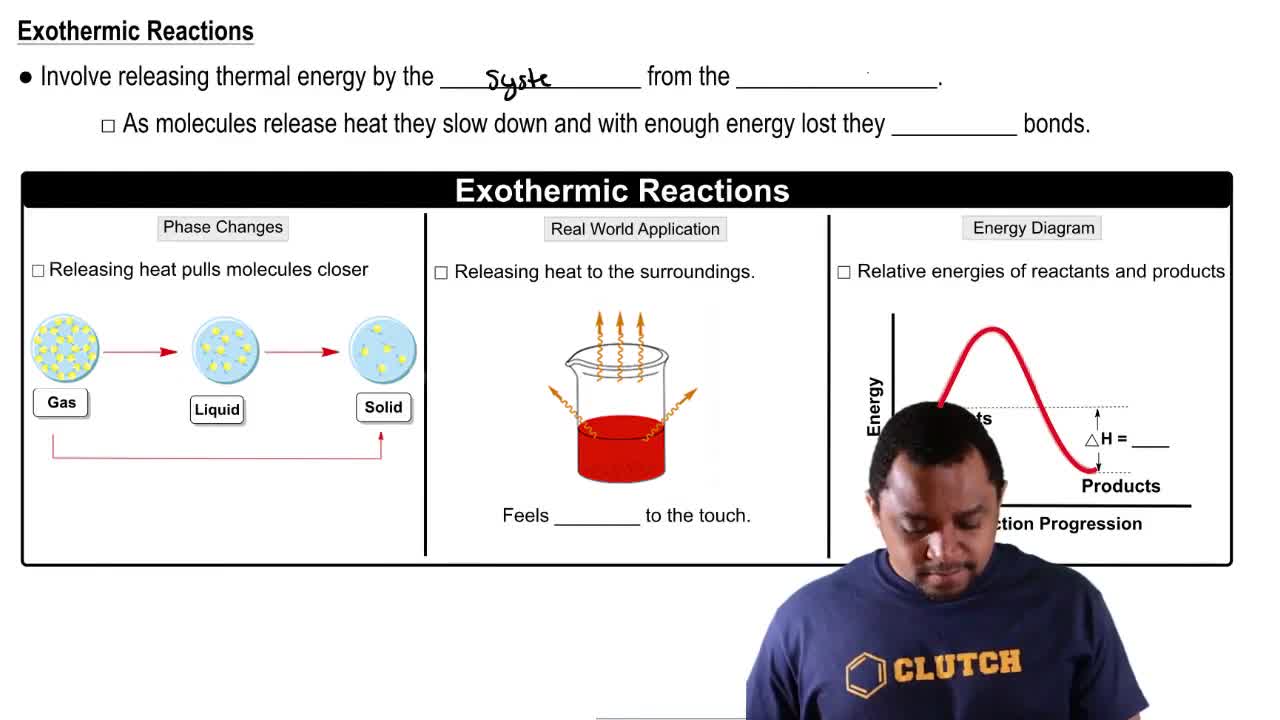
Endothermic and Exothermic Reactions

Endothermic reactions absorb heat from their surroundings, resulting in a positive change in enthalpy (∆H > 0). Conversely, exothermic reactions release heat, leading to a negative change in enthalpy (∆H < 0). In this case, since the reaction has a positive ∆H of +69 kcal/mol, it indicates that the reaction is endothermic.
추천 영상:
가이드 코스
02:38
Endothermic & Exothermic Reactions

Enthalpy Change (∆H)

Enthalpy change (∆H) is a measure of the heat content of a system at constant pressure. It indicates whether a reaction absorbs or releases energy. A positive ∆H value signifies that energy is absorbed during the reaction, while a negative value indicates energy release. For the given reaction, the positive ∆H confirms it is endothermic.
추천 영상:
가이드 코스
01:17
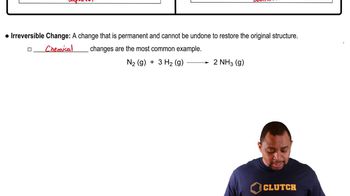
Physical & Chemical Changes

Equilibrium Constant (K)

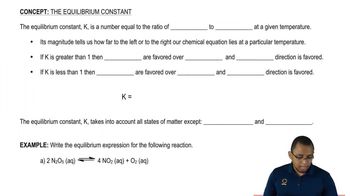
The equilibrium constant (K) quantifies the ratio of the concentrations of products to reactants at equilibrium for a reversible reaction. A very small K value, such as 2.68 x 10^-29, suggests that at equilibrium, the reactants are favored over the products, indicating that the formation of ozone (O3) from oxygen (O2) is not favored under standard conditions.
추천 영상:
가이드 코스
02:50
The Equilibrium Constant Concept 1