
교과서 질문
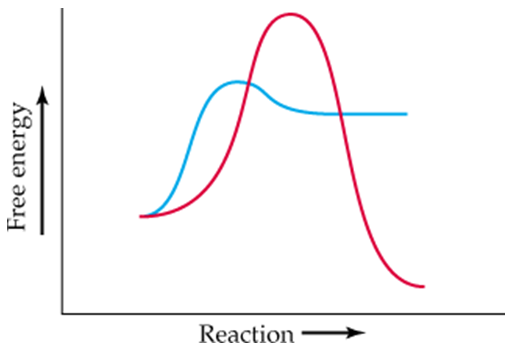
Is the total enthalpy (H) of the reactants for an endothermic reaction greater than or less than the total enthalpy of the products?
2177
views

 검증된 단계별 안내
 01:04
01:04
 06:17
06:17 00:37
00:37Is the total enthalpy (H) of the reactants for an endothermic reaction greater than or less than the total enthalpy of the products?
The following diagram portrays a reaction of the type A(s) → B(g) + C(g), where the different-colored spheres represent different molecular structures. Assume that the reaction has ∆H = +9.1 kcal/mol (+38.1 kJ/mol).
b. Is the reaction likely to be spontaneous at all temperatures, nonspontaneous at all temperatures, or spontaneous at some but nonspontaneous at others?
What effect do the listed changes have on the position of the equilibrium in the reaction of carbon with hydrogen?
C(s) + 2 H2(g) ⇌ CH4(g) ∆H = -18 kcal/mol (-75kJ/mol)
b. Increasing pressure by decreasing volume
What effect do the listed changes have on the position of the equilibrium in the reaction of carbon with hydrogen?
C(s) + 2 H2(g) ⇌ CH4(g) ∆H = -18 kcal/mol (-75kJ/mol)
c. Allowing CH4 to escape continuously from the reaction vessel
What effect do the listed changes have on the position of the equilibrium in the reaction of carbon with hydrogen?
C(s) + 2 H2(g) ⇌ CH4(g) ∆H = -18 kcal/mol (-75kJ/mol)
a. Increasing temperature
The following diagram portrays a reaction of the type A(s) → B(g) + C(g), where the different-colored spheres represent different molecular structures. Assume that the reaction has ∆H = +9.1 kcal/mol (+38.1 kJ/mol).
a. What is the sign of ∆S for the reaction?