Ch.7 Chemical Reactions: Energy, Rate and Equilibrium
McMurry - Fundamentals of General, Organic, and Biological Chemistry 8th Edition
McMurry8th EditionFundamentals of General, Organic, and Biological ChemistryISBN: 9780134015187당신이 사용하는 게 아니라요?교과서 변경
7장, 문제 22a

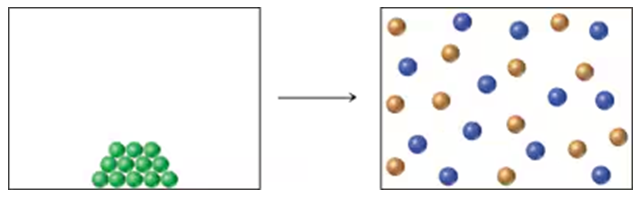
The following diagram portrays a reaction of the type A(s) → B(g) + C(g), where the different-colored spheres represent different molecular structures. Assume that the reaction has ∆H = +9.1 kcal/mol (+38.1 kJ/mol).

a. What is the sign of ∆S for the reaction?

검증된 단계별 안내
1
Step 1: Analyze the reaction type. The reaction is A(s) → B(g) + C(g), where a solid (A) is breaking down into two gaseous products (B and C). This indicates a phase change from solid to gas, which typically increases disorder in the system.
Step 2: Examine the diagram. On the left side, the solid A is represented as tightly packed spheres, indicating a highly ordered structure. On the right side, the products B and C are represented as dispersed spheres, indicating a less ordered, more random distribution.
Step 3: Recall the concept of entropy (∆S). Entropy is a measure of disorder or randomness in a system. When a solid transitions to gases, the particles gain freedom of movement, leading to an increase in entropy.
Step 4: Consider the number of particles. The reaction produces two gaseous products from one solid reactant. The increase in the number of particles contributes to a higher degree of randomness and thus a positive ∆S.
Step 5: Conclude the sign of ∆S. Based on the increase in disorder and the transition from a solid to gases, the sign of ∆S for this reaction is positive.

비슷한 문제에 대한 검증된 영상 답변:

이 영상 해법은 위 문제에 도움이 된다고 튜터들이 추천한 것입니다.
영상 길이:
2m

주요 개념

질문에 올바르게 답하기 위해 반드시 이해해야 하는 핵심 개념들은 다음과 같습니다.

Entropy (∆S)

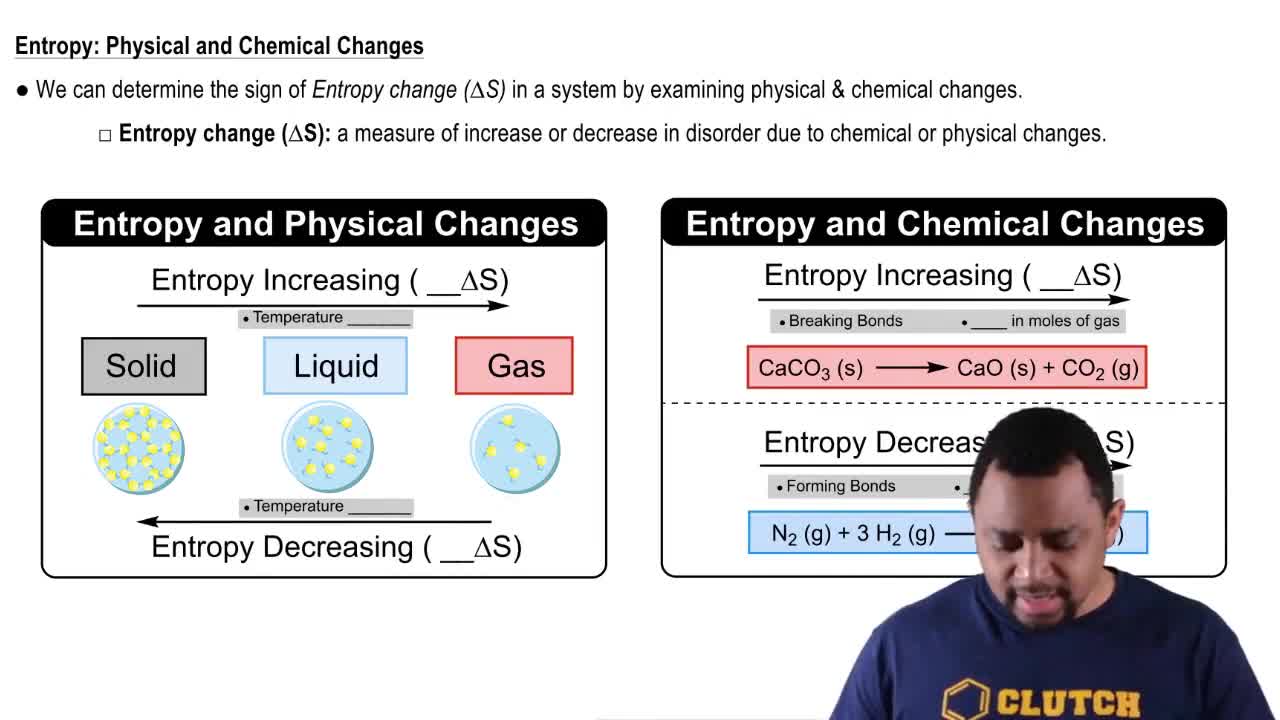
Entropy, denoted as ∆S, is a measure of the disorder or randomness in a system. In chemical reactions, an increase in the number of gas molecules typically leads to an increase in entropy, as gases have more freedom of movement compared to solids. Therefore, understanding how the state of matter changes in a reaction is crucial for determining the sign of ∆S.
추천 영상:
가이드 코스
03:22
Entropy (Simplified) Concept 2

Phase Changes

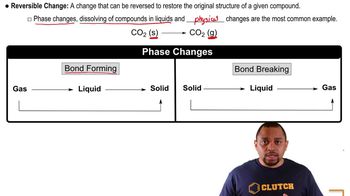
Phase changes refer to the transitions between solid, liquid, and gas states of matter. In the given reaction, a solid (A) is converted into two gaseous products (B and C). This transition from a more ordered solid state to a less ordered gaseous state generally results in an increase in entropy, which is essential for predicting the sign of ∆S.
추천 영상:
가이드 코스
03:40
Physical & Chemical Changes

Thermodynamics of Reactions

Thermodynamics studies the relationships between heat, work, and energy in chemical reactions. The enthalpy change (∆H) and entropy change (∆S) are key components in determining the spontaneity of a reaction. In this case, the positive ∆H indicates that the reaction absorbs heat, but the increase in the number of gas molecules suggests that ∆S is likely positive, which can influence the overall spontaneity of the reaction.
추천 영상:
가이드 코스
01:18
First Law of Thermodynamics