Ch.8 Gases, Liquids and Solids
McMurry - Fundamentals of General, Organic, and Biological Chemistry 8th Edition
McMurry8th EditionFundamentals of General, Organic, and Biological ChemistryISBN: 9780134015187당신이 사용하는 게 아니라요?교과서 변경
8장, 문제 91

What is a liquid's heat of vaporization?

검증된 단계별 안내
1
The heat of vaporization is the amount of energy required to convert one mole (or one gram, depending on the units) of a liquid into a gas at its boiling point, without changing its temperature.
This process involves breaking the intermolecular forces (such as hydrogen bonds, dipole-dipole interactions, or London dispersion forces) that hold the liquid molecules together.
The heat of vaporization is typically expressed in units of joules per mole (J/mol) or calories per gram (cal/g).
To calculate the heat of vaporization, you can use the formula: q = n × ΔHvap, where q is the heat absorbed, n is the number of moles, and ΔHvap is the molar heat of vaporization.
The heat of vaporization is a critical property in understanding phase changes and is used in applications such as distillation, refrigeration, and understanding the energy requirements of evaporation.

비슷한 문제에 대한 검증된 영상 답변:

이 영상 해법은 위 문제에 도움이 된다고 튜터들이 추천한 것입니다.
영상 길이:
2m

주요 개념

질문에 올바르게 답하기 위해 반드시 이해해야 하는 핵심 개념들은 다음과 같습니다.

Heat of Vaporization

The heat of vaporization is the amount of energy required to convert a unit mass of a liquid into vapor without a change in temperature. This process occurs at the boiling point of the liquid and is crucial for understanding phase changes. It reflects the strength of intermolecular forces within the liquid; stronger forces result in a higher heat of vaporization.
추천 영상:

Intermolecular Forces

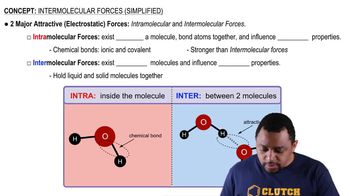
Intermolecular forces are the forces of attraction or repulsion between neighboring particles (atoms, molecules, or ions). These forces play a significant role in determining the physical properties of substances, including boiling points and heat of vaporization. Types of intermolecular forces include hydrogen bonding, dipole-dipole interactions, and London dispersion forces, with hydrogen bonds being the strongest.
추천 영상:
가이드 코스
01:59
Intermolecular Forces (Simplified) Concept 1

Phase Change

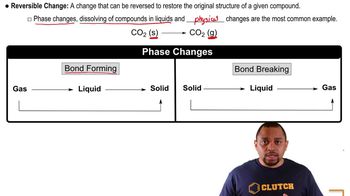
A phase change refers to the transition of a substance from one state of matter to another, such as from liquid to gas during vaporization. This process involves energy transfer, where heat is absorbed or released. Understanding phase changes is essential for grasping concepts like heat of vaporization, as it highlights how energy influences the state of a substance.
추천 영상:
가이드 코스
03:40
Physical & Chemical Changes