Ch.8 Gases, Liquids and Solids
McMurry - Fundamentals of General, Organic, and Biological Chemistry 8th Edition
McMurry8th EditionFundamentals of General, Organic, and Biological ChemistryISBN: 9780134015187당신이 사용하는 게 아니라요?교과서 변경
8장, 문제 100

Use the kinetic–molecular theory to explain why gas pressure increases if the temperature is raised and the volume is kept constant.

검증된 단계별 안내
1
The kinetic–molecular theory states that gas particles are in constant, random motion and that their collisions with the walls of the container create pressure.
When the temperature of a gas increases, the average kinetic energy of the gas particles also increases. This is because temperature is directly proportional to the kinetic energy of the particles.
As the kinetic energy of the particles increases, they move faster and collide with the walls of the container more frequently and with greater force.
Since the volume is kept constant, the gas particles have less space to move, which means the increased frequency and force of collisions directly result in a higher pressure.
In summary, the increase in temperature leads to an increase in the kinetic energy of gas particles, which causes more frequent and forceful collisions with the container walls, thereby increasing the gas pressure.

비슷한 문제에 대한 검증된 영상 답변:

이 영상 해법은 위 문제에 도움이 된다고 튜터들이 추천한 것입니다.
영상 길이:
1m

주요 개념

질문에 올바르게 답하기 위해 반드시 이해해야 하는 핵심 개념들은 다음과 같습니다.

Kinetic-Molecular Theory

The kinetic-molecular theory describes the behavior of gases in terms of particles in constant motion. It posits that gas particles are small, widely spaced, and move randomly at high speeds. This theory helps explain how temperature, pressure, and volume are interrelated in gaseous systems.
추천 영상:
가이드 코스
01:19
Kinetic Molecular Theory Concept 1

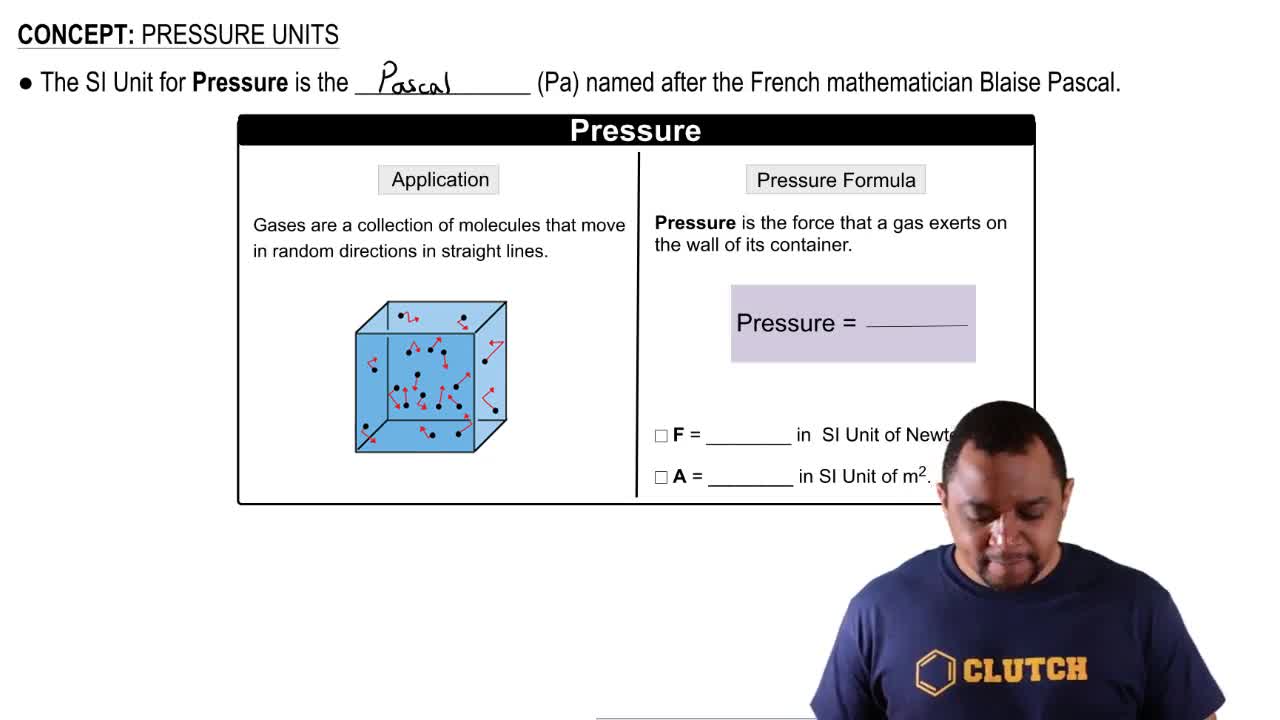
Gas Pressure

Gas pressure is defined as the force exerted by gas particles colliding with the walls of their container. When the temperature of a gas increases, the kinetic energy of the particles also increases, leading to more frequent and forceful collisions with the container walls, which results in higher pressure.
추천 영상:
가이드 코스
01:15
Pressure Units Concept 1

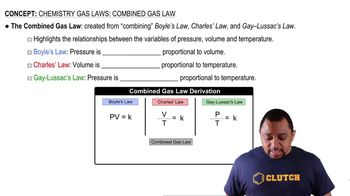
Charles's Law

Charles's Law states that the volume of a gas is directly proportional to its temperature when pressure is held constant. However, in this scenario, since the volume is constant, an increase in temperature leads to an increase in pressure, as described by the ideal gas law, which combines these relationships.
추천 영상:
가이드 코스
01:43
Chemistry Gas Laws: Combined Gas Law