Ch.9 Solutions
McMurry - Fundamentals of General, Organic, and Biological Chemistry 8th Edition
McMurry8th EditionFundamentals of General, Organic, and Biological ChemistryISBN: 9780134015187당신이 사용하는 게 아니라요?교과서 변경
9장, 문제 22b

The diagram to the right shows plots of vapor pressure versus temperature for a solvent and a solution.
b. What is the approximate boiling-point elevation for the solution?
<IMAGE>

검증된 단계별 안내
1
Identify the boiling point of the pure solvent from the vapor pressure versus temperature graph. The boiling point corresponds to the temperature at which the vapor pressure of the solvent equals the external pressure (typically 1 atm).
Identify the boiling point of the solution from the same graph. This is the temperature at which the vapor pressure of the solution equals the external pressure (again, typically 1 atm).
Calculate the boiling-point elevation (ΔT_b) by subtracting the boiling point of the pure solvent from the boiling point of the solution: ΔT_b = T_solution - T_solvent.
Recall that boiling-point elevation is a colligative property, meaning it depends on the number of solute particles in the solution, not their identity. The relationship is given by the formula: ΔT_b = i × K_b × m, where i is the van't Hoff factor, K_b is the boiling-point elevation constant for the solvent, and m is the molality of the solution.
If needed, verify the calculated ΔT_b using the graph and ensure consistency with the colligative property formula. This step helps confirm the accuracy of the boiling-point elevation determined from the graph.

비슷한 문제에 대한 검증된 영상 답변:

이 영상 해법은 위 문제에 도움이 된다고 튜터들이 추천한 것입니다.
영상 길이:
14m

주요 개념

질문에 올바르게 답하기 위해 반드시 이해해야 하는 핵심 개념들은 다음과 같습니다.

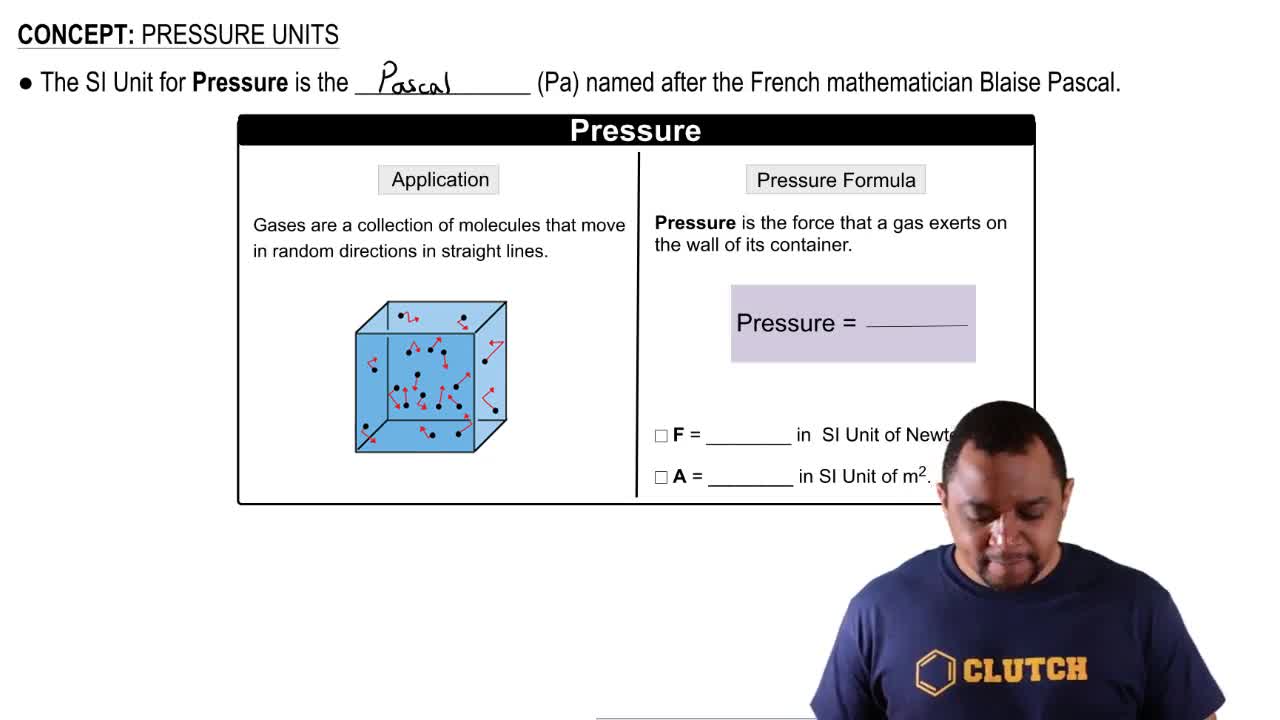
Vapor Pressure

Vapor pressure is the pressure exerted by a vapor in equilibrium with its liquid or solid phase at a given temperature. It indicates how readily a substance will evaporate; higher vapor pressure means a substance evaporates more easily. In the context of solutions, the presence of solute particles lowers the vapor pressure compared to the pure solvent.
추천 영상:
가이드 코스
01:15
Pressure Units Concept 1

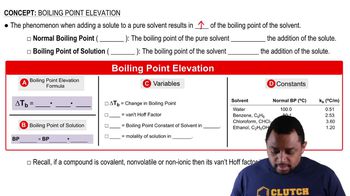
Boiling Point Elevation

Boiling point elevation is a colligative property that describes the increase in the boiling point of a solvent when a solute is added. This phenomenon occurs because the solute particles disrupt the solvent's ability to vaporize, requiring a higher temperature to reach the boiling point. The extent of boiling point elevation can be calculated using the formula ΔT_b = i * K_b * m, where 'i' is the van 't Hoff factor, 'K_b' is the ebullioscopic constant, and 'm' is the molality of the solution.
추천 영상:
가이드 코스
03:05
Boiling Point Elevation Concept 1

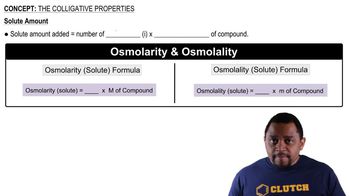
Colligative Properties

Colligative properties are properties of solutions that depend on the number of solute particles in a given amount of solvent, rather than the identity of the solute. These properties include boiling point elevation, freezing point depression, vapor pressure lowering, and osmotic pressure. Understanding colligative properties is essential for predicting how the addition of solute affects the physical properties of a solvent, such as its boiling point.
추천 영상:
가이드 코스
01:27
The Colligative Properties Concept 3