Ch.9 Solutions
McMurry - Fundamentals of General, Organic, and Biological Chemistry 8th Edition
McMurry8th EditionFundamentals of General, Organic, and Biological ChemistryISBN: 9780134015187당신이 사용하는 게 아니라요?교과서 변경
9장, 문제 21

When 1.0 mol of HF is dissolved in 1.0 kg of water, the boiling point of the resulting solution is 100.5 °C. Is HF a strong or weak electrolyte? Explain.

검증된 단계별 안내
1
Determine the boiling point elevation (ΔT_b) by subtracting the boiling point of pure water (100.0 °C) from the boiling point of the solution (100.5 °C). This gives ΔT_b = 0.5 °C.
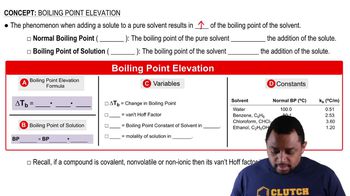
Use the boiling point elevation formula: ΔT_b = i × K_b × m, where i is the van 't Hoff factor, K_b is the boiling point elevation constant for water (0.512 °C·kg/mol), and m is the molality of the solution.
Calculate the molality (m) of the solution using the formula m = rac{\(\text{moles of solute}\)}{\(\text{kg of solvent}\)}. Here, the moles of HF are 1.0 mol, and the mass of water is 1.0 kg, so m = 1.0 \, \(\text{mol/kg}\).
Rearrange the boiling point elevation formula to solve for the van 't Hoff factor (i): i = rac{ΔT_b}{K_b × m}. Substitute the known values: ΔT_b = 0.5 \, \(\text{°C}\), K_b = 0.512 \, \(\text{°C·kg/mol}\), and m = 1.0 \, \(\text{mol/kg}\).
Interpret the value of i. If i is close to 1, HF is a weak electrolyte because it does not fully dissociate in water. If i is significantly greater than 1, HF is a strong electrolyte because it dissociates into ions completely.

비슷한 문제에 대한 검증된 영상 답변:

이 영상 해법은 위 문제에 도움이 된다고 튜터들이 추천한 것입니다.
영상 길이:
3m

주요 개념

질문에 올바르게 답하기 위해 반드시 이해해야 하는 핵심 개념들은 다음과 같습니다.

Electrolytes

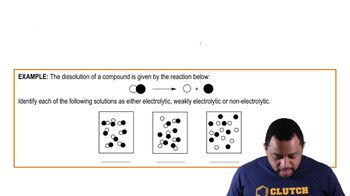
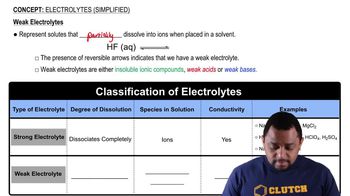
Electrolytes are substances that dissociate into ions when dissolved in water, allowing the solution to conduct electricity. They can be classified as strong or weak based on their degree of ionization. Strong electrolytes completely dissociate into ions, while weak electrolytes only partially dissociate, resulting in fewer ions in solution.
추천 영상:
가이드 코스
01:07
Electrolytes (Simplified) Example 3

Boiling Point Elevation

Boiling point elevation is a colligative property that describes how the boiling point of a solvent increases when a solute is added. The extent of this elevation depends on the number of solute particles in the solution. In this case, the increase in boiling point from 100 °C to 100.5 °C indicates that the solute (HF) contributes to the solution's overall particle concentration.
추천 영상:
가이드 코스
03:05
Boiling Point Elevation Concept 1

HF as an Electrolyte

Hydrofluoric acid (HF) is classified as a weak electrolyte because it only partially ionizes in solution. When HF dissolves in water, it produces a mixture of HF molecules and ions (H⁺ and F⁻), but not all HF molecules dissociate. The observed boiling point elevation suggests that HF does contribute to the solution's ionic strength, but its incomplete dissociation confirms its status as a weak electrolyte.
추천 영상:
가이드 코스
02:33
Electrolytes (Simplified) Concept 2