Ch.12 Introduction to Organic Chemistry: Alkanes
McMurry - Fundamentals of General, Organic, and Biological Chemistry 8th Edition
McMurry8th EditionFundamentals of General, Organic, and Biological ChemistryISBN: 9780134015187당신이 사용하는 게 아니라요?교과서 변경
12장, 문제 63

Write the formulas of the three doubly brominated isomers formed when 2-methylpropane reacts with Br2 in the presence of light.

검증된 단계별 안내
1
Understand the reaction: The reaction involves the bromination of 2-methylpropane (C₄H₁₀) in the presence of light, which indicates a free radical halogenation mechanism. Bromine (Br₂) reacts with the hydrocarbon, replacing hydrogen atoms with bromine atoms.
Identify the structure of 2-methylpropane: The molecule has a central carbon atom bonded to three methyl groups (CH₃) and one hydrogen atom. Its structure is: CH₃-C(CH₃)₂-H.
Determine the possible positions for bromination: In 2-methylpropane, there are two types of hydrogen atoms: one primary hydrogen (on the CH₃ groups) and one tertiary hydrogen (on the central carbon). Bromination can occur at these positions.
Account for doubly brominated products: Since the problem asks for doubly brominated isomers, consider all combinations where two bromine atoms replace two hydrogens. These replacements can occur on the same carbon or on different carbons.
Write the formulas of the isomers: The three possible doubly brominated isomers are: (1) 1,1-dibromo-2-methylpropane (both bromines on the central carbon), (2) 1-bromo-2-bromo-2-methylpropane (one bromine on the central carbon and one on a methyl group), and (3) 2,2-dibromo-2-methylpropane (both bromines on the same methyl group).

비슷한 문제에 대한 검증된 영상 답변:

이 영상 해법은 위 문제에 도움이 된다고 튜터들이 추천한 것입니다.
도움이 되었나요?

주요 개념

질문에 올바르게 답하기 위해 반드시 이해해야 하는 핵심 개념들은 다음과 같습니다.

Doubly Brominated Isomers

Doubly brominated isomers are organic compounds that contain two bromine atoms attached to different carbon atoms in a hydrocarbon chain. In the case of 2-methylpropane, the presence of multiple carbon atoms allows for various configurations where bromine can be substituted, leading to distinct isomers with different structural arrangements.
추천 영상:
가이드 코스
2:16
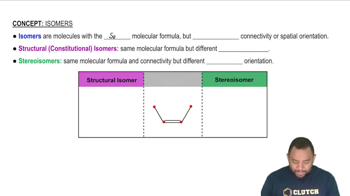
Isomers Concept 1

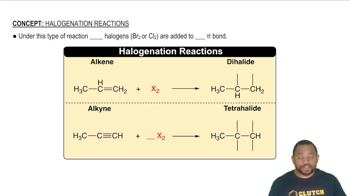
Radical Halogenation

Radical halogenation is a chemical reaction where alkanes react with halogens (like Br₂) in the presence of light or heat, resulting in the substitution of hydrogen atoms with halogen atoms. This process involves the formation of free radicals, which are highly reactive species that drive the substitution reactions, leading to the formation of various isomers.
추천 영상:
가이드 코스
1:11
Halogenation Reactions Concept 1

Structural Isomers

Structural isomers are compounds that have the same molecular formula but differ in the arrangement of atoms. In the context of the reaction of 2-methylpropane with Br₂, the different positions of bromine substitution on the carbon skeleton create distinct structural isomers, each with unique chemical properties despite having the same overall composition.
추천 영상:
가이드 코스
2:16
Isomers Concept 1