Ch.13 Alkenes, Alkynes, and Aromatic Compounds
McMurry - Fundamentals of General, Organic, and Biological Chemistry 8th Edition
McMurry8th EditionFundamentals of General, Organic, and Biological ChemistryISBN: 9780134015187당신이 사용하는 게 아니라요?교과서 변경
13장, 문제 79b

Ocimene, a compound isolated from the herb basil, has three double bonds and the IUPAC name 3,7-dimethyl-1, 3-6-octatriene.
b. Draw the structure of the compound formed if enough HBr is added to react with all the double bonds in ocimene.

검증된 단계별 안내
1
Identify the structure of ocimene based on its IUPAC name: 3,7-dimethyl-1,3,6-octatriene. This means the compound has a chain of 8 carbon atoms (octa-) with three double bonds (-triene) located at positions 1, 3, and 6. Additionally, there are methyl groups (-CH₃) attached to carbons 3 and 7.
Draw the structure of ocimene, ensuring the correct placement of the double bonds and methyl groups. The structure should show a linear chain of 8 carbons with double bonds at the specified positions and methyl groups branching off at carbons 3 and 7.
Understand the reaction with HBr: When HBr reacts with a compound containing double bonds, the hydrogen (H⁺) adds to the carbon with more hydrogens (Markovnikov's rule), and the bromine (Br⁻) adds to the carbon with fewer hydrogens.
Apply the reaction to each double bond in ocimene. For each double bond, add H⁺ to one carbon and Br⁻ to the other carbon. Repeat this process for all three double bonds in the molecule.
Draw the final structure of the product. The resulting compound will have no double bonds, as all have been saturated by the addition of HBr. Each carbon that was part of a double bond will now have either a hydrogen or a bromine atom attached, depending on the Markovnikov addition rule.

비슷한 문제에 대한 검증된 영상 답변:

이 영상 해법은 위 문제에 도움이 된다고 튜터들이 추천한 것입니다.
도움이 되었나요?

주요 개념

질문에 올바르게 답하기 위해 반드시 이해해야 하는 핵심 개념들은 다음과 같습니다.

Hydrohalogenation

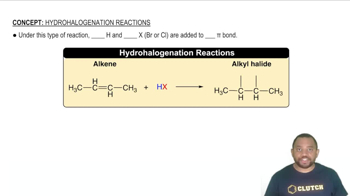
Hydrohalogenation is a chemical reaction where a hydrogen halide (like HBr) adds across the double bonds of alkenes or alkynes. In the case of ocimene, the addition of HBr to its double bonds will result in the formation of bromoalkanes. This reaction typically follows Markovnikov's rule, where the hydrogen atom attaches to the carbon with more hydrogen substituents, leading to the most stable carbocation intermediate.
추천 영상:
가이드 코스
0:56
Hydrohalogenation Reaction Concept 1

Alkene Reactivity

Alkenes are hydrocarbons that contain at least one carbon-carbon double bond, making them more reactive than alkanes. The presence of double bonds allows for various addition reactions, such as hydrohalogenation, hydrogenation, and halogenation. Understanding the reactivity of alkenes is crucial for predicting the products of reactions involving compounds like ocimene.
추천 영상:
가이드 코스
3:26
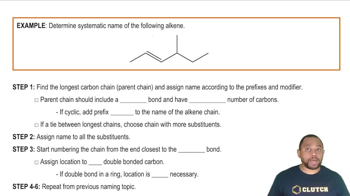
Naming Alkenes Example 1

IUPAC Nomenclature

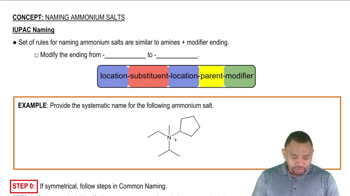
IUPAC nomenclature is a systematic method for naming chemical compounds, ensuring that each compound has a unique and descriptive name. For ocimene, the name 3,7-dimethyl-1,3,6-octatriene indicates its structure, including the positions of double bonds and substituents. Familiarity with IUPAC rules is essential for interpreting chemical names and drawing corresponding structures.
추천 영상:
가이드 코스
3:18
IUPAC Naming Concept 3